Performance Marketing Insights

Explore insights from Platformance on digital marketing innovation, performance advertising, and data-driven strategies. Read our latest articles for expert tips, industry trends, and a behind-the-scenes look at how we’re redefining performance marketing.

Blog

What is Programmatic Advertising: The Comprehensive Playbook

What is Programmatic Advertising: The Comprehensive Playbook

Master what programmatic advertising is. Complete 2026 MENA guide for automated media.
Platformance
April 22, 2026
12
min read
Read More

Discover how programmatic advertising works, explore formats like CTV and display, and learn how automated ad buying transforms your relationship with consumers.

The Programmatic Landscape at a Glance

Before diving into definitions and mechanics, it helps to understand the scale of what we're discussing. Programmatic advertising is not a niche channel,  it is the dominant infrastructure of digital media buying worldwide.

The Programmatic Landscape at a Glance

These numbers set the stage: if you buy or plan to buy digital media, understanding programmatic is no longer optional. It is the table stakes of modern marketing.

Section 1: The Basics: Defining Programmatic Marketing & Campaigns

What is Programmatic Advertising? (The Programmatic Ad Meaning)

At its core, programmatic advertising is the automated, software-driven buying and selling of digital ad space in real time. Rather than a human account executive calling a publisher, negotiating rates, and faxing an insertion order, algorithms execute those decisions in milliseconds, matching the right ad to the right audience on the right platform at the optimal price.

Programmatic Advertising: The use of automated technology and algorithmic software to purchase digital advertising, replacing traditional, manual negotiation-based media buying. It encompasses all automated deal types, from open auctions to direct guaranteed deals.

It is critical to distinguish what programmatic advertising is not: it is not a single platform, not synonymous with Google Ads, and not limited to banner ads. It is an overarching methodology that spans display, video, audio, connected TV (CTV), digital out-of-home (DOOH), and native formats.

What is an Advertising Campaign in the Programmatic Era?

A traditional advertising campaign is a coordinated series of ads sharing a unified message, budget, and timeline across selected media. In the programmatic era, that definition expands considerably. Campaigns are no longer static schedules, they are dynamic, always-on machine learning models that continuously optimize themselves.

Key Shift: Traditional campaigns 'set and forget' based on upfront research. Programmatic campaigns self-optimize based on live performance data - adjusting bids, creatives, audiences, and placements in real time without human intervention.

This shift from scheduled placement to algorithmic optimization is the defining characteristic of modern programmatic marketing. The campaign becomes a living system, not a fixed media plan.

Programmatic Display Advertising vs. Other Digital Channels

Programmatic display advertising refers specifically to automated buying of visual ad placements - banners, rich media, interstitials, and responsive display units, across publisher websites and apps. But programmatic buying now extends far beyond the original 'display' category:

  • Display: Banner ads, rich media, and responsive image units across web and mobile.
  • Video: Pre-roll, mid-roll, and out-stream video on publishers and streaming platforms.
  • Connected TV (CTV/OTT): Programmatic TV ads served on smart TVs and streaming services.
  • Native: Ads matched to the look and feel of the editorial environment (e.g. in-feed ads).
  • Audio: Programmatic ads on streaming music and podcast platforms (Spotify, Pandora).
  • Digital Out-of-Home (DOOH): Digital billboards and transit displays bought programmatically.

This breadth underscores why programmatic digital marketing is considered an infrastructure layer, not a channel, sitting beneath all forms of digital media.

Section 2: The Mechanics: How Does Programmatic Advertising Work?

How Do Programmatic Ads Work? (The Ecosystem)

Understanding programmatic requires mapping its tech ecosystem. When a user loads a webpage, a complex automated auction fires and completes, all within the time it takes the page to render. Here is the full lifecycle of a programmatic impression:

  • User visits a publisher's website or app. The publisher's ad server detects an available ad slot.
  • The publisher's Supply-Side Platform (SSP) broadcasts a bid request to multiple Ad Exchanges, transmitting available data: page URL, ad dimensions, and privacy-compliant audience signals.
  • Demand-Side Platforms (DSPs) receive the bid request simultaneously. Each DSP evaluates whether the impression matches any active campaign's targeting criteria (demographics, interests, context, location, retargeting lists).
  • Eligible DSPs submit bids (CPM values) within milliseconds. In a standard second-price auction, the highest bidder wins but pays the second-highest bid price plus $0.01.
  • The winning ad creative is returned to the SSP and served in the publisher's ad slot.
  • Post-impression, performance data flows back to the DSP to inform future bidding decisions via machine learning.

According to Google's own ad tech documentation, the median latency for a real-time bidding transaction is under 100 milliseconds, faster than a human blink. This speed is what makes audience-level targeting at scale possible.

The core components of the programmatic ecosystem are:

How Do Programmatic Ads Work

Real-Time Bidding (RTB) vs. Programmatic Guaranteed: Key Differences

A common misconception in programmatic digital marketing is treating RTB and programmatic as synonymous. Real-Time Bidding is a subset of programmatic - one specific auction mechanism within a broader universe of deal types:

Real-Time Bidding (RTB) vs. Programmatic Guaranteed: Key Differences

For advanced media buyers, the strategic question is not which model to use, but how to balance each in the media plan. Open RTB maximizes reach and cost efficiency; Programmatic Guaranteed provides brand-safe premium placements with delivery certainty for high-stakes campaigns.

Industry Best Practice (Forrester Research): Sophisticated programmatic buyers typically allocate 60–70% of spend to open/PMP environments for scale, and reserve 20–30% for Programmatic Guaranteed for high-visibility placements and guaranteed delivery against reach goals.

How Does Programmatic TV Advertising Work? (CTV & OTT)

Connected TV (CTV) advertising is the fastest-growing segment of the programmatic ecosystem. CTV refers to internet-connected television devices, smart TVs, streaming sticks (Roku, Fire TV), and gaming consoles, that serve ads via apps and streaming services.

How Does Programmatic TV Advertising Work? (CTV & OTT)

Outcome-Based Pricing

The fundamental advantage of programmatic TV over traditional linear television buying is the shift from demographic proxies (e.g., 'women aged 25–54 watching prime time') to individual household and viewer-level targeting using first- and third-party data signals. This exact level of precision is what makes outcome-based pricing possible, allowing advertisers to focus on real results through.

  • Behavioral targeting: Served to households that recently searched for a specific product category.
  • CRM-matched targeting: First-party customer lists matched to streaming account data.
  • Lookalike modeling: Expand reach to households that mirror your best customers' attributes.
  • Frequency management: Cap how often a specific household sees your ad across devices.

OTT (Over-the-Top) refers to the delivery method, streaming content delivered directly over the internet, bypassing traditional cable infrastructure. CTV is the device; OTT is the delivery mechanism. In practice, the terms are often used interchangeably in media buying contexts.

Section 3: Strategy & Impact: Consumer Relationships & Promotions

How Programmatic Advertising Changes the Relationship Between a Company and Consumers

Perhaps the most profound shift enabled by programmatic advertising is not technological,  it is relational. Traditional mass-media advertising operated on a broadcast model: one message crafted for a broad audience, delivered via one-to-many channels. Programmatic inverts this entirely.

The Broadcast Model: 'We made this ad. We'll put it in front of everyone and hope it resonates with someone.'

The Programmatic Model: 'We know who is most likely to convert. We serve the most contextually relevant message to each individual, at the moment they are most receptive.'

This shift has three major implications for the brand-consumer relationship:

  • Hyper-Personalization at Scale: Dynamic Creative Optimization (DCO) technology allows brands to assemble thousands of ad variations from modular creative assets, swapping headlines, images, CTAs, and offers based on real-time audience signals. A running shoe brand can simultaneously serve a 'Marathon Training' creative to a user who recently browsed running gear, and a 'Weekend Warrior' creative to a user whose behavioural profile suggests casual fitness interests.
  • First-Party Data Activation: As third-party cookies phase out, brands that have built robust first-party data strategies gain a decisive advantage. Connecting CRM data to a CDP or DMP allows advertisers to target their own customers and high-value prospects with precision that mass media cannot replicate. This is the foundation of a modern, consent-based consumer relationship.
  • The Risk of Overexposure: The same targeting precision that enables relevance can erode trust if mismanaged. Excessive ad frequency, showing the same consumer the same ad dozens of times in a short period - is a well-documented cause of brand fatigue and negative sentiment. Programmatic platforms must include frequency capping as a standard safeguard in any campaign setup.

A 2024 Edelman Trust Barometer study found that 63% of consumers are more likely to buy from brands that communicate in a personalised, relevant way, while 71% will disengage if ads feel intrusive or repetitive. Programmatic is the tool that determines which experience consumers receive.

Advertising vs. Sales Promotion in the Programmatic Context

Understanding this distinction is critical for structuring programmatic campaigns with clear, measurable objectives, whether your goal is building upper-funnel awareness or driving lower-funnel direct response, such as a pay-per-lead model.

Advertising vs. Sales Promotion in the Programmatic Context

A common strategic error is using programmatic exclusively for lower-funnel retargeting (sales promotion) while neglecting upper-funnel brand investment. Research by Binet & Field (The Long and the Short of It) demonstrates that sustained long-term profitability requires approximately 60% brand investment and 40% activation spend - a ratio many programmatic-first media plans have inverted.

Section 4: Implementation: Execution, Safety & Budgets

Integrating DSPs and DMPs into Your Marketing Stack

For marketing managers looking to move from managed service to a more sophisticated in-house or hybrid programmatic setup, the integration of your tech stack is the foundational step. Here is a practical framework:

Step 1: Audit Your First-Party Data: Conduct a full inventory of your customer data assets - CRM records, website behavioural data, transactional data, and loyalty programme information. This is your most valuable targeting asset in a cookieless world.

Step 2: Select & Implement a CDP or DMP: A Customer Data Platform (CDP) unifies first-party data across sources and creates persistent, resolvable customer profiles. A DMP is better suited to managing anonymised third-party data for audience extension. Most modern enterprise stacks use a CDP as the primary data layer.

Step 3: When evaluating the best programmatic advertising platforms, you will find that all major DSPs (DV360, The Trade Desk, Xandr/Microsoft Invest) offer direct data connectors or API integrations with leading CDPs. Work with your platform account team to establish secure data sharing pipelines and audience sync schedules (typically refreshed every 24–48 hours).

Step 4: Build Audience Segments: Create tiered audience segments: existing customers, lapsed customers, high-value prospects (lookalike models), and contextual/intent audiences. Each segment should have a tailored message, bid strategy, and creative approach.

Step 5: Implement Conversion Tracking: Deploy universal pixel tags or server-side conversion events to feed post-click and post-view attribution data back to the DSP. Without closed-loop measurement, the algorithm cannot optimise toward your actual business outcomes.

Ensuring Brand Safety and Preventing Ad Fraud

Brand safety and ad fraud are the two most cited concerns among marketing managers evaluating programmatic for the first time - and rightfully so. When programmatic campaigns run without proper governance, ads can appear next to brand-damaging content, and a material portion of budget can be consumed by bots rather than human audiences.

Brand safety and ad fraud

Industry-standard countermeasures include:

Pre-bid Verification Tools: Platforms like DoubleVerify (DV) and Integral Ad Science (IAS) integrate directly with DSPs to block bid requests from fraudulent, off-target, or unsafe inventory before any spend occurs. These are non-negotiable for any campaign running at scale.

ads.txt / Sellers.json: IAB Tech Lab standards that allow publishers to publicly declare their authorised digital sellers. DSPs that enforce ads.txt compliance ensure your spend reaches authorised publishers only, significantly reducing domain spoofing.

Inclusion & Exclusion Lists: Curated allow-lists (trusted publishers only) and block-lists (known unsafe domains) provide the most precise brand safety controls. Inclusion-list-only buying on PMPs offers the highest safety, at the cost of scale.

Invalid Traffic (IVT) Filtering: Sophisticated IVT encompasses the most advanced forms of bot fraud - traffic that mimics human behaviour patterns. General IVT (GIVT) filters are standard; SIVT filtration requires accredited third-party measurement partners certified by the Media Rating Council (MRC).

Budgeting: How Much Do You Need to Start With Programmatic?

One of the most frequently asked questions from first-time programmatic advertisers - and one where unrealistic expectations cause the most damage. There is no single correct answer, but there are structural principles every media buyer must understand.

How Much Do You Need to Start With Programmatic?

The most important budget principle is the algorithm's need for data: programmatic machine learning models typically require a minimum of 50–100 conversion events per optimisation period to exit the 'learning phase' and make statistically valid bid adjustments. Underfunding a campaign is one of the most common reasons programmatic fails to deliver results.

Expert Advice: Always allocate a dedicated test budget - at least 15–20% of your initial campaign budget - to audience and creative experimentation. Insights from testing are the primary source of competitive advantage in programmatic. The media itself is a commodity; the intelligence you extract from it is not.

Frequently Asked Questions About Programmatic Advertising

Q: Is programmatic advertising the same as Google Ads?

No. Google Ads is a single, closed advertising network operating within Google's owned properties (Search, YouTube, GDN). Programmatic advertising is a broad, open buying methodology that accesses thousands of publishers and ad exchanges simultaneously through Demand-Side Platforms (DSPs). While Google's DSP (DV360) is one programmatic platform, programmatic itself extends far beyond Google's walled garden - reaching inventory that Google Ads cannot access. For brands seeking scale, audience precision, and cross-channel reach, programmatic digital marketing complements rather than replaces Google Ads.

Q: Are Real-Time Bidding and programmatic advertising the same?

No. Real-Time Bidding (RTB) is one specific auction mechanism within the broader programmatic ecosystem - not the whole of it. Programmatic advertising also includes non-auction models such as Programmatic Guaranteed (fixed-price, reserved inventory), Private Marketplaces (invitation-only auctions), and Preferred Deals (fixed-price, first-look, non-guaranteed). Industry best practice recommends diversifying your programmatic ad strategy across multiple deal types to balance reach, cost efficiency, and brand safety.

Q: What is a DMP, and do I need one?

A Data Management Platform (DMP) is software that collects, organises, and activates first-, second-, and third-party audience data for targeting. Whether you need one depends on scale and data strategy: if you are running campaigns primarily on first-party CRM data, a Customer Data Platform (CDP) is often a better fit, as DMPs were primarily built around third-party cookie data whose availability is declining. Organisations running large-scale programmatic marketing with complex multi-source audience requirements benefit most from DMP or CDP integration.

Q: How is programmatic pricing structured?

Programmatic pricing is primarily structured on a Cost Per Mille (CPM) basis - the cost per 1,000 ad impressions - with CPMs determined dynamically during real-time auctions. Effective CPMs range from $0.50 to $2.50 on open exchange, $3 to $12 on Private Marketplaces, and $10 to $30+ on Programmatic Guaranteed deals, depending on audience quality, format, targeting depth, and platform fees. Advertisers should monitor win rates, viewability, and effective CPM in their DSP analytics to ensure their bids remain competitive without overpaying.

Q: Is programmatic advertising replacing people's jobs?

Programmatic technology is shifting job functions rather than eliminating them. Manual tasks - negotiating insertion orders, scheduling placements, trafficking creatives - are being automated, freeing practitioners to focus on strategic activities: audience architecture, data analysis, creative strategy, and campaign governance. Industry data consistently shows growing demand for programmatic specialists, data scientists, and ad operations professionals. The skill set required has evolved, not disappeared.

Q: Will programmatic expose my brand to harmful online environments?

Without active brand safety management, yes - this is a genuine risk. Programmatic ads can appear next to inappropriate content or on fraudulent sites if campaigns run without verification. You must implement pre-bid brand safety tools (such as DoubleVerify or Integral Ad Science), strict inclusion and exclusion lists, and MRC-accredited invalid traffic filtering. These measures are non-negotiable for any responsible programmatic programme. The risk is manageable; the mistake is treating brand safety as optional.

Q: Does programmatic advertising have self-service options?

Yes. Most major DSPs offer self-service dashboards, including The Trade Desk, Google DV360, Amazon DSP, and Xandr. However, self-service programmatic requires meaningful technical expertise: pixel implementation, audience architecture, bid strategy configuration, and creative trafficking all demand trained personnel. For businesses without dedicated programmatic expertise, starting with a managed service partner is advisable before transitioning to in-house operations.

Q: What types of ads use programmatic buying?

Programmatic buying supports a comprehensive range of formats: display (banner, rich media), video (pre-roll, mid-roll, out-stream), connected TV/OTT, digital audio (streaming music, podcasts), native (in-feed, content recommendation), and Digital Out-of-Home (DOOH).

This omnichannel capability - managed from a single DSP interface - is one of programmatic's core advantages over siloed, platform-specific buying. Dynamic Creative Optimisation (DCO) further allows advertisers to tailor formats to individual user behaviours at the creative level.

Conclusion: Why Programmatic Is the Infrastructure of Modern Media

Programmatic advertising is not a trend to evaluate. It is the foundational infrastructure through which the vast majority of digital advertising now flows. Understanding it - from the millisecond auction mechanics to the brand safety governance frameworks - is a professional requirement for any marketer operating in the digital ecosystem today.

The most successful programmatic programmes share three characteristics: they invest in clean, consented first-party data; they balance automation with human strategic oversight; and they treat measurement not as a reporting afterthought but as the engine of continuous optimisation.

Ready to scale your media buying? Speak with our programmatic specialists today for a free campaign audit.

Sources & Further Reading

  • eMarketer (2025). US Programmatic Digital Display Ad Spending Forecast.
  • MAGNA Global (2025). Global Advertising Forecast: 2025–2028.
  • Juniper Research (2023). The Future of Digital Advertising: Ad Fraud Loss Report.
  • DoubleVerify (2024). Global Insights Report: Media Quality & Performance.
  • Nielsen (2025). The Gauge: US TV & Streaming Report.
  • IAB Tech Lab (2024). ads.txt and Sellers.json Compliance Standards.
  • Forrester Research (2024). The Programmatic Buying Landscape.
  • Edelman (2024). Trust Barometer: Brand and Consumer Personalisation Study.
  • Binet, L. & Field, P. (2013). The Long and the Short of It. IPA.
  • Google Ad Manager (2024). Real-Time Bidding Technical Documentation.
  • Media Rating Council (MRC). Invalid Traffic Detection & Filtration Guidelines.
Outcome-Based Pricing & Pay Per Outcome Model: Transform Your Digital Advertising with Platformance

Outcome-Based Pricing & Pay Per Outcome Model: Transform Your Digital Advertising with Platformance

Outcome-based pricing lets brands pay only for real, verified results. Boost ROI with zero waste.
Waseem Afzal
November 28, 2025
6
min read
Read More

Introduction to Outcome-Based Pricing

Digital advertising in 2026 has evolved significantly across the MENA digital advertising ecosystem. Traditional pricing models like CPM and CPC often lead to inefficient ad spending, where advertisers pay for impressions or clicks that don’t convert into tangible results.

Outcome-based pricing (OBP) changes the rules. Instead of paying for activity, brands pay only for verified business outcomes such as leads, sales, or subscriptions. This performance-first approach ensures marketers invest in growth, not guesswork.

Platformance, a Dubai-based performance marketing platform, leads this shift through its Pay Per Outcome (PPO) model. Built on AI-driven optimization, first-party data intelligence, and transparent analytics, Platformance ensures advertisers pay only for measurable value.

Key highlights:

  • Advertisers pay only for outcomes that matter (leads, sales, or installs).
  • Proprietary analytics ensure fraud levels remain below 8 percent.
  • Transparent performance dashboards validate every result.

Learn more about our performance innovation strategies at Platformance.io or explore our Performance Marketing Models guide.

What Is Outcome-Based Pricing?

Outcome-based pricing is a pay-for-results advertising model focused on validated KPIs like qualified leads, confirmed sales, or completed app installs. It aligns ad spend directly with business success.

Examples of outcomes:

  • A verified sales lead
  • A completed e-commerce purchase
  • A high-intent app registration
  • A confirmed service booking

According to IAB MENA 2024, nearly 29 percent of digital ad budgets are wasted on non-performing impressions. Outcome-based pricing eliminates this inefficiency by tying spend directly to results, verified through AI-powered tracking and strict validation rules.

Outcome-Based Pricing Model vs Traditional Digital Advertising

Model What You Pay For Risk Transparency ROI Potential
CPM Ad impressions High Low Unclear
CPC Clicks Medium–High Medium Variable
CPA Form fills / actions Lower Higher Better
PPO (Outcome-Based Pricing) Validated results (sales, leads) Lowest Highest Maximum ROI

Unlike CPC (cost per click) or CPA (cost per action), the Pay Per Outcome model from Platformance focuses on realized business gains. It represents an evolved form of performance-based pricing, often called result-based billing or revenue-linked advertising.

Explore how the PPO model fits alongside CPA and CPL strategies in our related article on Performance-Based Advertising in MENA.

Benefits of Outcome-Based Pricing with Platformance

Outcome-based pricing through Platformance delivers tangible marketing efficiency and better ROI.

Primary benefits:

  • Guaranteed outcomes: Payment tied to verified business metrics, not vanity engagement.
  • Fraud protection: Less than 8 percent fraud rate through rigorous validation.
  • AI optimization: Dynamic learning systems improve conversion targeting.
  • Multi-channel reach: Campaigns run across web, mobile, affiliate, CTV, and retail media.
  • Cross-category expertise: Success in retail, finance, automotive, and telecom sectors.

Supporting metric: Brands using Platformance’s PPO campaigns have reported an average 2.7x higher ROI versus CPC campaigns across MENA.

Learn how these omnichannel optimizations scale through our resource: Omnichannel Marketing Performance Insights.

Challenges and How Platformance Solves Them

Outcome-based marketing frameworks require precise tracking and deep attribution expertise. Platformance simplifies execution through structured setup, transparent dashboards, and end-to-end campaign support.

Key challenges and solutions:

  • Outcome complexity: Simplified with custom KPI mapping and AI validation tools.
  • Ad fraud risk: Minimized through strict monitoring and direct publisher integrations.
  • Shift from CPC/CPM: Guided onboarding ensures smooth transition to result-based billing.

This adaptable model positions Platformance as a leader in MENA’s Pay For Performance Marketing ecosystem.

Implementing an Outcome-Based Pricing Strategy

Follow this simple framework to build high-performance PPO campaigns with Platformance.

Steps:

  1. Define measurable KPIs such as qualified leads, completed orders, or app conversions.
  2. Establish transparent validation criteria for each outcome.
  3. Launch campaigns across omnichannel touchpoints: search, social, CTV, affiliate, and retail.
  4. Monitor live dashboards for budget efficiency and verified ROI.
  5. Continuously optimize using AI-driven creative testing and audience refinement.

Discover advanced campaign setup models in Platformance’s Marketing Automation Hub.

Case Studies and Success Metrics

  • Noon: $4.5M incremental GMV generated via performance-based pricing.
  • KFC: 2,500 verified orders tracked and validated.
  • Stellantis: 647 qualified automotive leads delivered with <8 percent fraud.

Each campaign shows the transparency and reliability that outcome-based frameworks deliver in 2026’s digital landscape.

Future Trends in Outcome-Based Advertising

The industry is moving quickly toward transparent, data-first frameworks.

Upcoming trends:

  • Global shift toward data-driven, pay-for-performance models.
  • Enhanced attribution accuracy with AI and first-party data integration.
  • Post-cookie advertising focused on verifiable, consented outcomes.
  • Continuous innovation across retail media and conversion-rate-optimization ecosystems.

Platformance remains committed to shaping this movement through advanced CRO solutions, omnichannel execution, and predictive analytics.

Conclusion

Outcome-based pricing empowers advertisers to replace uncertainty with transparency. Rather than paying for clicks or impressions, brands now pay strictly for measurable business outcomes.

Platformance leads this transformation across the MENA region, offering AI-optimized Pay Per Outcome campaigns, fraud-controlled validation, and full insight transparency.

Next Steps:

  • Request a Demo and experience outcome-based advertising firsthand.
  • Download the Outcome-Based Marketing Guide.
  • Read our insights on Performance-Driven Advertising Trends 2026.
What Is Pay Per Lead? Performance-Based Lead Generation Explained

What Is Pay Per Lead? Performance-Based Lead Generation Explained

Learn what is pay per lead and how it boosts marketing ROI with real, verified leads, not clicks or impressions.
Waseem Afzal
November 1, 2025
6
min read
Read More

Data-Driven Growth through Pay Per Lead

Pay Per Lead (PPL) is changing how marketers drive growth and measure performance. At Platformance, we make it simple, transparent, and measurable, ensuring you pay only for verified results, not impressions or clicks.

Integrated across Programmatic Media, Affiliate Marketing, Retail Media, and Creator-Led Content, our outcome-based lead generation helps brands focus on real acquisition instead of vanity metrics.

Ready to see how outcome-based lead generation works? Book a Demo or Request a CRO Audit.

What Is Pay Per Lead and How It Works

In a Pay Per Lead model, advertisers pay only when a qualified lead is delivered, such as a completed form, demo booking, or phone call.

Unlike flat ad spends, PPL connects cost directly with outcomes, improving marketing efficiency.

Main Types of Pay Per Lead Models

  • Pay per qualified lead
  • Pay per appointment
  • Pay per call
  • Pay per sale
  • Pay per event or webinar lead

Outcome-based contracts (Platformance’s Pay-Per-Outcome model)

Each model can be adapted across tailored ad formats such as Dynamic, Adaptive, or Connected TV placements, depending on your campaign goals and audience behavior.

Step-by-Step: How to Launch a PPL Campaign

  • Define your Ideal Customer Profile and lead qualification parameters.
  • Choose the best channels: affiliate, programmatic, search, or social.
  • Launch and test using Platformance’s AI-driven targeting tools.
  • Validate leads via built-in anti-fraud and compliance filters.
  • Scale campaigns through continuous optimization and creative A/B testing.
Tip: Try our free campaign setup audit to identify quick wins for your funnel.

Pay Per Lead vs. Cost Per Acquisition (CPA)

With PPL, Platformance clients typically see up to 40% lower acquisition costs driven by advanced CRO and audience modeling.

CPA measures purchases, while PPL focuses on qualified leads - giving you predictable ROI and control.

How Platformance Validates and Protects Lead Quality

  • AI Validation: Proprietary filters detect fake entries, duplicates, and bots.
  • Call Tracking: Ensures leads are genuine engagements.
  • Manual Verification: Human teams confirm compliance before delivery.

Industry average fraud rates hover around 18%. Platformance keeps it below 8% through transparent reporting and continuous AI audits.

See how our validation engine keeps fraud below 8% - Explore Case Study

How AI Enhances Pay Per Lead Optimisation

Our AI systems go beyond bid adjustments. They model conversion likelihood using predictive scoring, optimise creative combinations, and rebalance spend to increase lead quality.

This ensures precision targeting across channels like Connected TV, Gaming Ads, and Contextual Display.

Benefits and Risks of PPL Campaigns

Advantages

  • Predictable ROI and scalable budgets
  • Sales-ready leads validated by real-time data
  • Transparent performance metrics through detailed analytics dashboards

Risks

Lead fraud, compliance issues (GDPR/CCPA), and under-optimised funnels - mitigated via continuous AI audits and cross-channel attribution.

Real-World Success: Platformance Case Highlights

Trusted by 60+ regional brands and backed by FAST Ventures, Platformance delivers an average 40% CPL reduction versus industry benchmarks.

Calculating and Reducing Cost Per Lead (CPL)

Formula: CPL = Total Spend ÷ Number of Leads

Use advanced segmentation, adaptive creatives, and conversion funnel optimisation to continuously reduce CPL while improving lead-to-sale ratios.

Conclusion: The Future of Outcome-Driven Marketing

Pay Per Lead gives marketers the power to invest in performance that truly scales.

With Platformance, brands gain more than leads, they gain measurable growth backed by transparency, AI, and outcome-based pricing.

Ready to turn performance into predictable growth?Experience Pay Per Lead campaigns that convert with AI, transparency, and measurable ROI.

Book a Demo | View Case Studies | Explore Outcome-Based Campaigns

FAQs About Pay Per Lead

Is Pay Per Lead legit and safe for my business?
Yes, when you partner with verified providers using validation and transparency frameworks like Platformance.

Can I control my budget and scale?
Absolutely. Our outcome-based system lets you scale spend based on verified lead volume.

How is PPL different from PPC or CPA?
PPL rewards performance by lead rather than click or sale, creating budget predictability for B2B marketers.

Best Programmatic Advertising Platforms 2026

Best Programmatic Advertising Platforms 2026

Explore 2026’s best programmatic ad platforms with AI‑driven targeting and real‑time optimization.
Waseem Afzal
October 28, 2025
6
min read
Read More

Quick Comparison: Top Programmatic Ad Platforms 2026

Platform Unique Feature Ideal For Pricing Model Fraud Control AI Capability
Platformance Outcome-based pricing with low fraud rate (<8%) Regional campaigns (MENA) Outcome-based Built-in fraud detection Advanced AI modeling
The Trade Desk Unified ID 2.0, omnichannel DSP Enterprises & agencies CPM & outcome hybrid Top-tier global compliance Predictive AI targeting
Google Ad Manager (DV360) Cross-channel audience integration Large-scale digital advertisers CPM Google Ads Verified ML-driven optimization
Amazon DSP Access to Amazon first-party retail data E-commerce & retail media CPM Amazon’s verified data sets AI shopper segmentation
Adobe Advertising Cloud Dynamic creative optimization Brands with multimedia budgets CPM Adobe Brand Safety Suite Cross-channel AI automation
Xandr (AppNexus) Premium publisher network Agencies, broadcasters CPM IAS integrated AI supply optimization
SmartyAds Self-service DSP/SSP SMEs & startups Flexible CPM Built-in fraud filter Adaptive AI bidding
MediaMath Cross-device personalization Data-driven advertisers Outcome-based MRC certified Machine learning optimization
PubMatic Trusted SSP and yield management Publishers & networks Revenue share Fraud-free verified Predictive supply AI
StackAdapt Native ad focus & analytics Content marketers CPM GDPR compliant Contextual AI targeting

Introduction

Programmatic advertising is one of the fastest growing segments in digital marketing. In 2026, advertisers rely on it for scale, precision, and measurable ROI. As digital ecosystems evolve with AI‑powered ad buying and cookieless targeting, selecting the right platform is crucial for efficiency and compliance.

What Is Programmatic Advertising?

Programmatic advertising is the automated buying and selling of digital ads using algorithms and real‑time bidding (RTB). It integrates datadriven targeting with AI learning to optimise campaigns across channels, devices, and audience segments.

Benefits of Programmatic Advertising

  • Faster transactions and campaign automation
  • Smarter AI‑driven targeting and optimisation
  • Real‑time performance reporting
  • Access to omnichannel ad inventory
  • Improved ROI through precision targeting

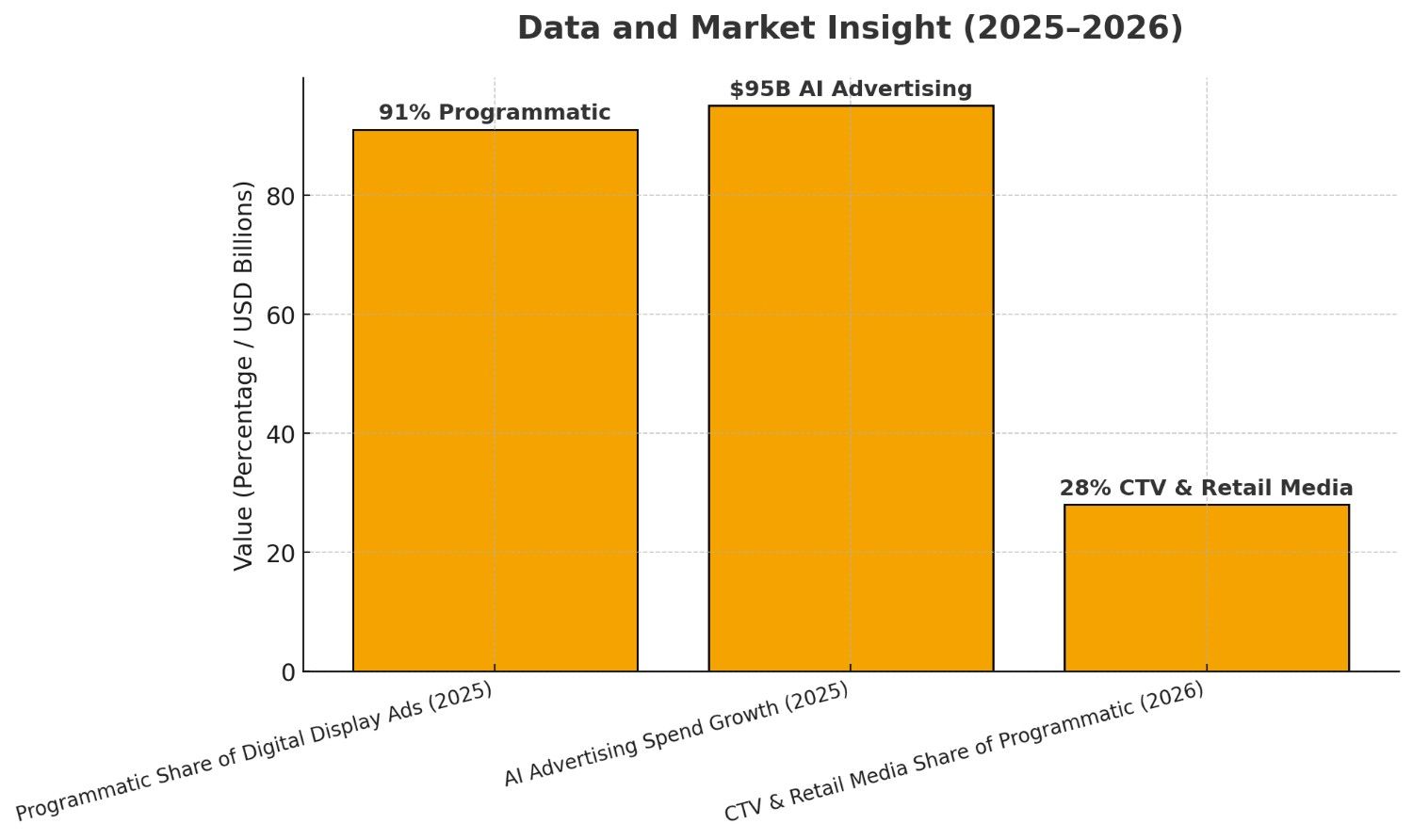
Data and Market Insight (2026 Statistics)

  • 91% of global digital display ad spending will be purchased programmatically by 2026 (eMarketer Forecast).
  • AI advertising expenditure is set to climb to $95 billion globally, up 34% year-on-year (Google Marketing Live 2026).(Explore AI adoption trends shaping MENA's digital economy).
  • CTV and retail media DSPs are projected to capture 28% of programmatic budgets by 2026 (Statista Report).
best platforms for programmatic advertising

Types of Programmatic Platforms

  • DSPs (DemandSide Platforms)
  • SSPs (SupplySide Platforms)
  • Ad Exchanges
  • Ad Servers
  • DMPs (Data Management Platforms)Modern tools often merge several functions, unifying data, bidding, and analytics in one environment.

Best AI‑Powered Programmatic Platforms in 2026

AI has completely reshaped the efficiency and personalization of ad buying.

  • Platformance: Uses outcome-based optimization to reduce waste by 30%.
  • The Trade Desk: Employs predictive modeling for advanced user segmentation.
  • Google DV360: Integrates ML bidding models across YouTube and Display.
  • Adobe Cloud: Adds generative creative optimization.

Top Programmatic Tools for Video & CTV Advertising

Connected TV and streaming ads are now integral to modern media buying.

  • Xandr: Offers premium broadcaster inventory for OTT streaming.
  • PubMatic: Focuses on CTV yield management.
  • Amazon DSP: Gives ecommerce advertisers CTV access to high intent audiences.

Industry trend: Retail Media Networks are merging with CTV buying, letting brands target shoppers across devices while Privacy Sandbox reforms reshape tracking models.

Top Programmatic Advertising Platforms of 2026

  1. Platformance – AIpowered regional DSP for MENA with <8% fraud rate
  2. The Trade Desk – Global reach with Unified ID 2.0 identity system
  3. Google Ads Manager (DV360) – Powerful enterprisescale platform
  4. Amazon DSP – Retail media strength and shopper data edge
  5. Adobe Advertising Cloud – Crosschannel creative automation
  6. Xandr (AppNexus) – Advanced auction intelligence for publishers
  7. SmartyAds – Costeffective solution for SMBs
  8. MediaMath – Flexible DSP for omnichannel targeting
  9. PubMatic – Trusted SSP maintaining brand safety
  10. StackAdapt – Native ad leader with contextual intelligence

Recommendations by Business Type

Platform Unique Feature Ideal For Pricing Model Fraud Control AI Capability
Platformance Outcome-based pricing with low fraud rate (<8%) Regional campaigns (MENA) Outcome-based Built-in fraud detection Advanced AI modeling
The Trade Desk Unified ID 2.0, omnichannel DSP Enterprises & agencies CPM & outcome hybrid Top-tier global compliance Predictive AI targeting
Google Ad Manager (DV360) Cross-channel audience integration Large-scale digital advertisers CPM Google Ads Verified ML-driven optimization
Amazon DSP Access to Amazon first-party retail data E-commerce & retail media CPM Amazon’s verified data sets AI shopper segmentation
Adobe Advertising Cloud Dynamic creative optimization Brands with multimedia budgets CPM Adobe Brand Safety Suite Cross-channel AI automation
Xandr (AppNexus) Premium publisher network Agencies, broadcasters CPM IAS integrated AI supply optimization
SmartyAds Self-service DSP/SSP SMEs & startups Flexible CPM Built-in fraud filter Adaptive AI bidding
MediaMath Cross-device personalization Data-driven advertisers Outcome-based MRC certified Machine learning optimization
PubMatic Trusted SSP and yield management Publishers & networks Revenue share Fraud-free verified Predictive supply AI
StackAdapt Native ad focus & analytics Content marketers CPM GDPR compliant Contextual AI targeting

Challenges in Programmatic Buying

  • Ad fraud and brand safety breaches
  • Data privacy and cookieless targeting adaptation
  • Multi‑platform orchestration complexity
  • Rising CPMs in high‑demand verticals
  • Attribution gaps between CTV and display channels

Expert Insight: How AI is Reshaping Programmatic Efficiency in 2026

AI no longer just powers bidding - it predicts behavioral intent, generates adaptive creatives, and automatically reallocates budget across the highest‑performing audiences.

Advertisers leveraging first‑party data activation and real‑time contextual AI are achieving up to 40% stronger conversion efficiency, according to 2026 case studies by Trade Desk and Platformance.(Explore case studies here).

Case Example: Platformance’s AI Optimization

A telecom brand using Platformance cut media waste by 30% and improved ROI by 40%, powered by AI audience modeling and automated creative rotation across display and CTV.

Future of Programmatic in 2026

Expect major advancements in:

  • Retail Media DSP integrations with CTV streaming platforms
  • Cookieless identity frameworks built on AIdriven cohort modeling
  • Automationfirst campaign designs, reducing manual bid management
  • Crosschannel affordability for SMEs entering programmatic for the first time

The line between performance marketing and programmatic media will continue to blur - making adaptability and AI data maturity the defining competitive edge.

FAQs

What are the types of programmatic platforms?

  • Demand-Side Platforms (DSPs): Used by advertisers and agencies to buy digital ad inventory automatically across websites, apps, and Connected TV.
  • Supply-Side Platforms (SSPs): Used by publishers to sell ad impressions and manage yield.
  • Ad Exchanges: Marketplaces where DSPs and SSPs transact via real-time bidding (RTB).
  • Ad Servers: Systems that deliver, track, and measure ad performance.
  • Data Management Platforms (DMPs): Tools that collect and activate audience data for precise targeting.

Which programmatic platform has the best ROI?

ROI depends on your campaign goals, geography, and pricing model.

  • Global marketers often cite The Trade Desk and Google DV360 for omnichannel reach and data scale.
  • E-commerce advertisers gain strong returns through Amazon DSP due to its shopper-data advantage.
  • MENA-based brands see higher efficiency with Platformance, whose outcome-based pricing ensures advertisers pay only for measurable results often cutting wasted spend by up to 30 percent.

Is programmatic advertising suitable for small businesses?

Yes. Small and mid-size businesses can benefit from programmatic campaigns thanks to:

  • Budget flexibility: Self-serve DSPs and managed-service options allow smaller spends.
  • Smart targeting: AI and first-party data make every impression count.
  • Outcome-based models: Platforms like Platformance let SMBs pay for real conversions instead of impressions.

Programmatic is no longer exclusive to big brands, it’s scalable for any business focused on measurable growth.

What makes Platformance different?

Platformance stands out through its Pay-Per-Outcome model, regional expertise, and AI-driven optimisation.Key differentiators include:

  • Outcome-based pricing: Advertisers pay only for verified business results (leads, sales, or sign-ups).
  • Low fraud rate: Under 8 percent, among the lowest in MENA.
  • Local strength: Deep publisher relationships and cultural insight across Arabic-speaking markets.

AI personalisation: Automated creative delivery and targeting that continuously improve ROI.

How can I choose the right DSP for my brand?

Follow these steps to make an informed decision:

  • Define objectives: Are you focused on awareness, lead generation, or direct sales?
  • Compare pricing models: Evaluate CPM, CPC, CPA, and outcome-based options.
  • Assess targeting and data capabilities: Look for AI, contextual, and first-party integrations.
  • Review transparency and support: Choose a platform with clear reporting and fraud protection.
  • Test performance: Run a pilot campaign and measure cost-per-outcome before scaling.

For advertisers in the Middle East, Platformance offers the optimal mix of transparency, automation, and regional insight.