Compare costs, targeting precision, and ROI. Discover which ad buying strategy, automated or manual, is right for your budget, goals, and audience.
The State of Play: Two Worlds, One Budget Decision
Every marketing budget is a zero-sum game. Every dollar you commit to programmatic is a dollar not going to a direct publisher deal, a magazine spread, or a radio spot and vice versa. The question is never really 'which is better?' The question is: which mix is right for your campaign objectives, your audience, your budget, and your risk tolerance?
Before unpacking the mechanics of each approach or evaluating the Best Programmatic Advertising Platforms, it helps to understand where the industry currently sits on this spectrum:


These numbers tell a clear story: programmatic has won the volume war. But 'dominant' does not mean 'universally superior.' Non-programmatic advertising from direct publisher deals to print, radio, and out-of-home retains clear advantages in specific contexts that data-driven platforms cannot easily replicate.
Core Differences - Programmatic vs. Non-Programmatic Advertising
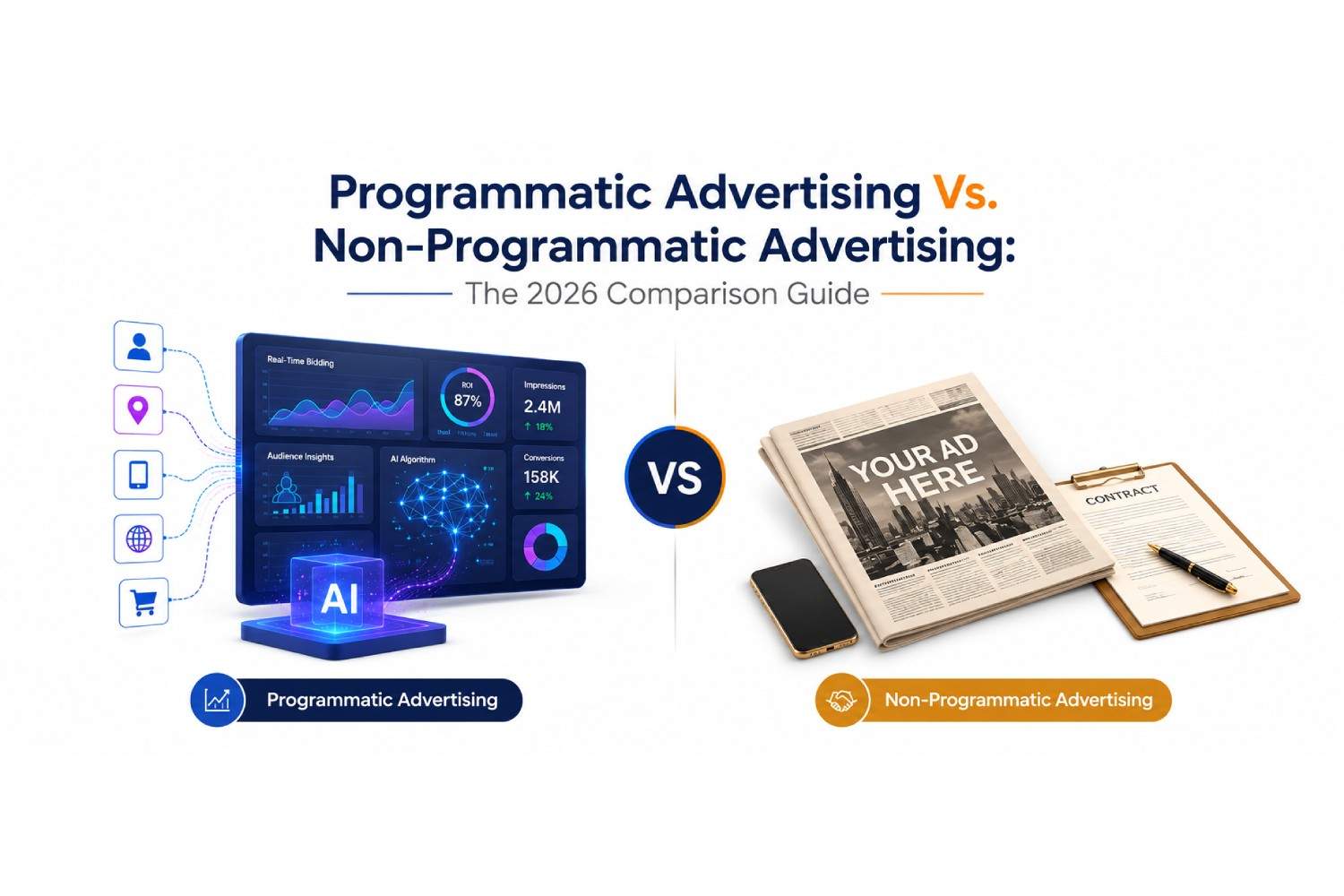
At their heart, these two methods differ on one fundamental dimension: whether a human or an algorithm makes the buying decision.
Programmatic: The automated, software-driven buying and selling of digital ad inventory using algorithms, real-time auctions, and audience data signals. No human negotiation is involved at the point of purchase.
Non-Programmatic: The manual purchasing of advertising, whether digital or traditional, through direct negotiation between an advertiser (or their agency) and a publisher or media owner. Requires human contracts, insertion orders, and scheduled placements.
This is not simply a digital vs. traditional divide. Non-programmatic advertising includes both legacy media (print, radio, TV) AND direct digital deals such as a media buyer emailing a premium news site to secure a homepage takeover. The defining factor is human negotiation, not the medium.

The Spectrum of Buying: RTB, Programmatic Direct, and Traditional
A common misconception is that programmatic and non-programmatic are binary opposites. In practice, the modern advertising landscape exists on a spectrum with 'Programmatic Direct' sitting squarely in the middle as a hybrid of both worlds:
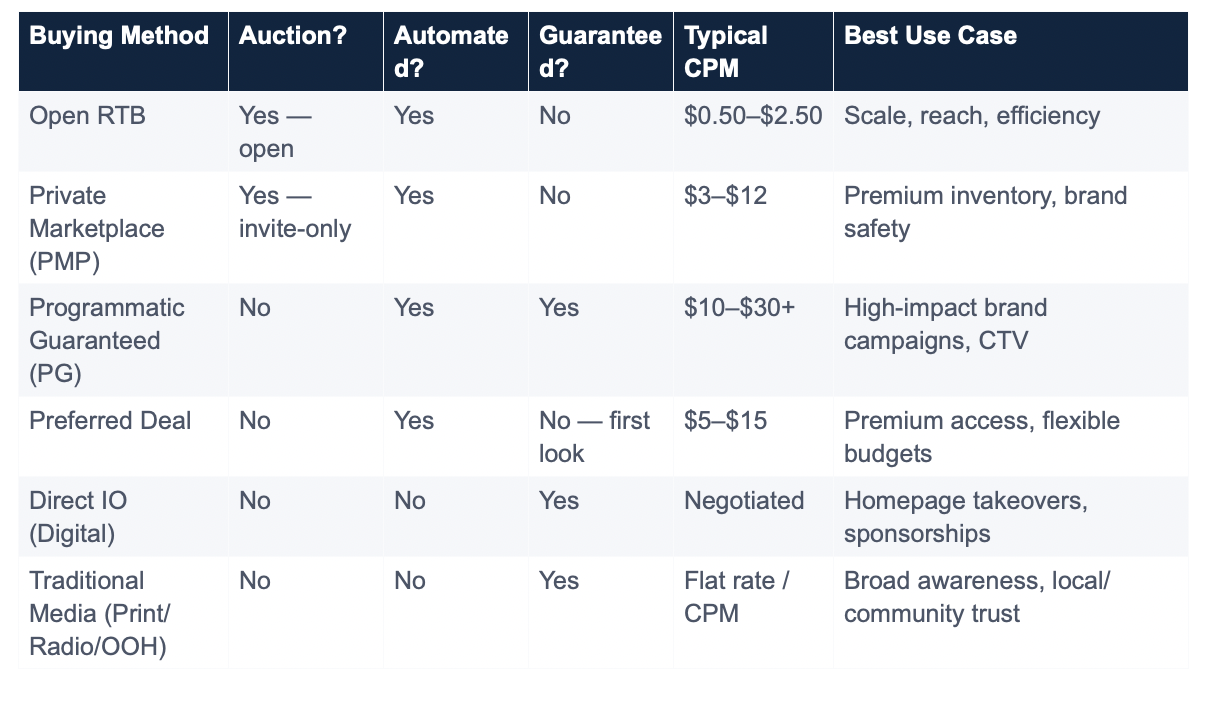
Key Insight: Programmatic Direct (Programmatic Guaranteed + Preferred Deals) gives advertisers the targeting and automation advantages of programmatic technology, while preserving the guaranteed placement and premium inventory access of traditional direct buying. For enterprise marketers, this hybrid tier is often the most strategic middle ground.
Cost & Budgeting - Is Programmatic Cheaper Than Direct Buying?
This is one of the most misunderstood questions in media planning. The honest answer is: it depends entirely on what you're measuring. Programmatic advertising can deliver lower CPMs on open exchanges but it carries a set of costs that traditional direct buying does not. Understanding the full cost picture is essential before committing budget.
The Programmatic Cost Stack: What You're Actually Paying For
When you allocate $10,000 to a programmatic campaign, the full journey of that dollar looks roughly like this in a managed DSP environment:

Industry Benchmark: The ANA (Association of National Advertisers) and ISBA studies consistently find that 40–50 cents of every programmatic dollar never reaches a publisher's actual ad impression. This 'ad tech tax' is the most important cost variable separating programmatic's stated CPM from its effective CPM.
This does not mean programmatic is more expensive than direct buying but it means the comparison must be made on effective CPM (eCPM) and cost-per-result, not on headline CPM rates alone.
Non-Programmatic / Direct: The True Cost of Manual Buying
Direct and traditional advertising carry their own cost structures that are less visible but equally real:

Budget Accessibility: Who Can Afford Each Approach?

Practical Note for SMBs: Programmatic is significantly more accessible than it was five years ago. Self-serve DSPs like The Trade Desk's Galileo, Amazon Advertising, and Meta Advantage+ allow campaigns to start from as little as $500/month. The barrier is no longer budget, it's the knowledge and time required to manage the platform effectively. For most SMBs, starting with a managed service agency and a modest test budget is the lowest-risk path.
Targeting, Measurement & Risk - Evaluating Your Strategy
Algorithmic Targeting vs. Broad Demographics
This is the dimension where programmatic advertising holds its most decisive advantage over traditional non-programmatic methods. The difference is not merely technical it is a fundamentally different philosophy of how to reach an audience.
Traditional media buying targets containers , a TV time slot, a magazine section, a radio format, and infers that the audience inside that container shares relevant characteristics. A car brand buying space in a motoring magazine is making a reasonable demographic inference. Programmatic advertising targets individuals, not containers.

Data Point: A 2024 Google/Ipsos study found that contextually targeted programmatic campaigns delivered 73% higher purchase intent lift compared to demographically targeted non-programmatic placements in the same product categories. However, the same study noted that brand recall remained 12% higher for TV/print placements, reinforcing that the two approaches serve different objectives.
Measuring ROI and Campaign Performance
Perhaps the most operationally significant difference between programmatic and non-programmatic advertising is the speed and granularity of measurement. This is not a marginal advantage it fundamentally changes how campaigns can be managed.

This measurement gap matters most for performance-oriented campaigns. If your primary KPI is cost per acquisition (CPA) or return on ad spend (ROAS), programmatic's real-time attribution provides a decisive advantage.
If your goal is to Build Awareness and establish cultural credibility, where the impact of a double-page spread in a prestige magazine is difficult to quantify but very real, traditional direct buying may be equally effective at a measurable level, with additional intangible benefits.
Brand Safety, Ad Fraud, and the Trust Equation
No honest comparison between programmatic and non-programmatic advertising is complete without addressing the most significant risk factor of automated buying: the combination of ad fraud and brand safety failure.
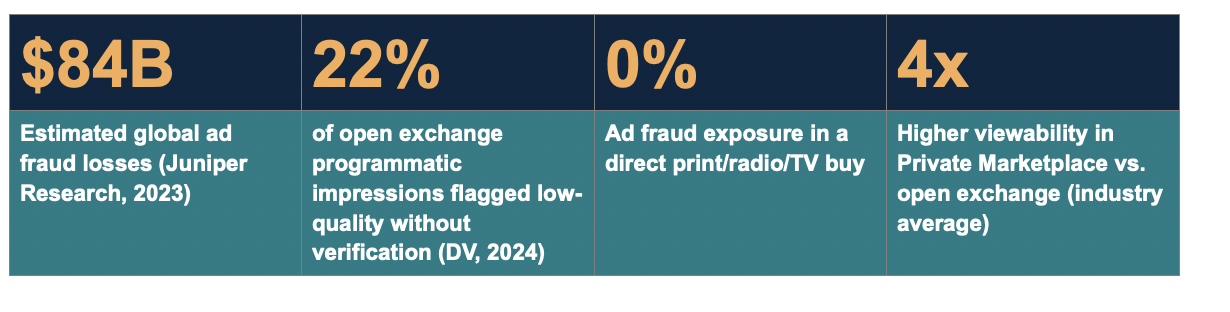
The fundamental brand safety advantage of non-programmatic advertising is certainty. When you purchase a full-page ad in a specific magazine, you know exactly what editorial content surrounds it. When you buy a 30-second radio spot, you know which programme it appears in. Direct digital IO buys on premium publishers carry the same certainty - your ad will appear on that site, in that position, for that duration.
Programmatic advertising, particularly on open exchanges, cannot offer that certainty by default. Ads can and do appear next to brand-unsafe content without proper governance. The industry has developed a robust toolkit to manage this risk:
- Pre-bid verification (IAS / DoubleVerify): Blocks unsafe inventory before any spend. Non-negotiable for any programmatic programme.
- ads.txt / Sellers.json enforcement: Ensures spend only reaches authorised sellers. Eliminates most domain spoofing.
- Curated PMPs and inclusion lists: Trading exclusively with known, vetted publishers and closed Retail Media environments provides near-direct-buy safety levels.
- Brand safety keyword block lists: Prevents ads appearing adjacent to specific content categories (news, violence, etc.).
- MRC-accredited IVT filtering: Eliminates sophisticated bot traffic from spend. Required for enterprise campaigns.
For Local Businesses: Traditional advertising, local newspaper ads, community radio, local TV spots, direct mail , carries an inherent trust advantage that programmatic cannot replicate algorithmically. A study by the Nielsen Trust in Advertising report found that 82% of consumers trust print ads more than digital ads. For brands whose primary competitive advantage is local community presence, this trust premium has tangible commercial value.
Making the Choice -When to Use Programmatic vs. Non-Programmatic
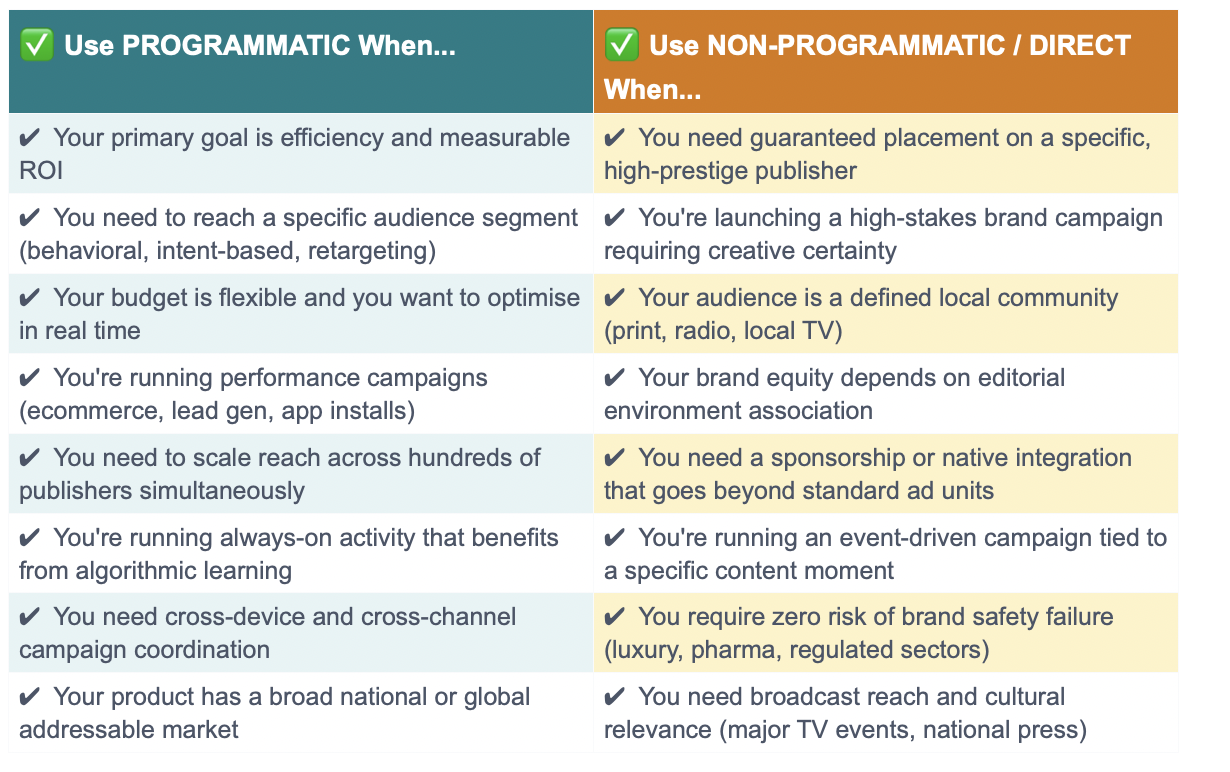
The most valuable strategic insight in this comparison is also the least intuitive: the question is almost never 'programmatic OR non-programmatic.' For most businesses above SMB scale, the optimal answer is a calibrated mix of both with allocation decisions driven by campaign objective, audience, and media context.
That said, there are clear cases where one approach is definitively superior. The framework below is designed to make that determination systematic.
The Decision Framework: Choosing Your Buying Method
Advice for Small Businesses: Launching Your First Programmatic Campaign
If you're a small or local business that has primarily relied on traditional advertising local print, radio, flyers, or direct mail the transition to programmatic can feel daunting. The technology is real but the barriers have dropped considerably. Here is a practical starting framework:
Start with retargeting, not prospecting: The easiest and most measurable first programmatic campaign is one that re-engages people who have already visited your website. Install a universal pixel, let it build an audience of 500–1,000 visitors, then launch a retargeting campaign with a clear offer to Generate Qualified Leads. Expect CPMs of $1–$3 and meaningful lift in conversion rates.
Use a managed service to start: Self-serve DSPs require technical expertise. Engaging a managed service provider or a digital agency with programmatic capabilities for your first 3–6 months allows you to learn the channel's mechanics without the operational risk of managing it yourself.
Set a true test budget: Programmatic algorithms require data to learn. Budget a minimum of $1,500–$2,500/month for at least 60 days before evaluating performance. Campaigns cut short before the algorithm exits its learning phase will always underperform.
Don't abandon traditional media overnight: For local businesses, traditional advertising often carries trust signals that programmatic cannot replicate. A complementary mix local newspaper ad for awareness + programmatic retargeting for conversion is frequently more effective than either channel alone.
Advice for Enterprise: The Hybrid Strategy
Enterprise marketing directors face a different challenge: not whether to use programmatic, but how to structure the balance between programmatic, direct digital, and traditional media to maximise full-funnel performance.
The evidence strongly supports a hybrid approach rather than wholesale migration to programmatic. Binet & Field's extensive IPA analysis demonstrates that the most profitable long-term media strategies balance automated efficiency (lower-funnel activation) with premium, brand-safe, high-attention placements (upper-funnel brand investment).
A practical enterprise hybrid framework allocates budget across three distinct tiers:

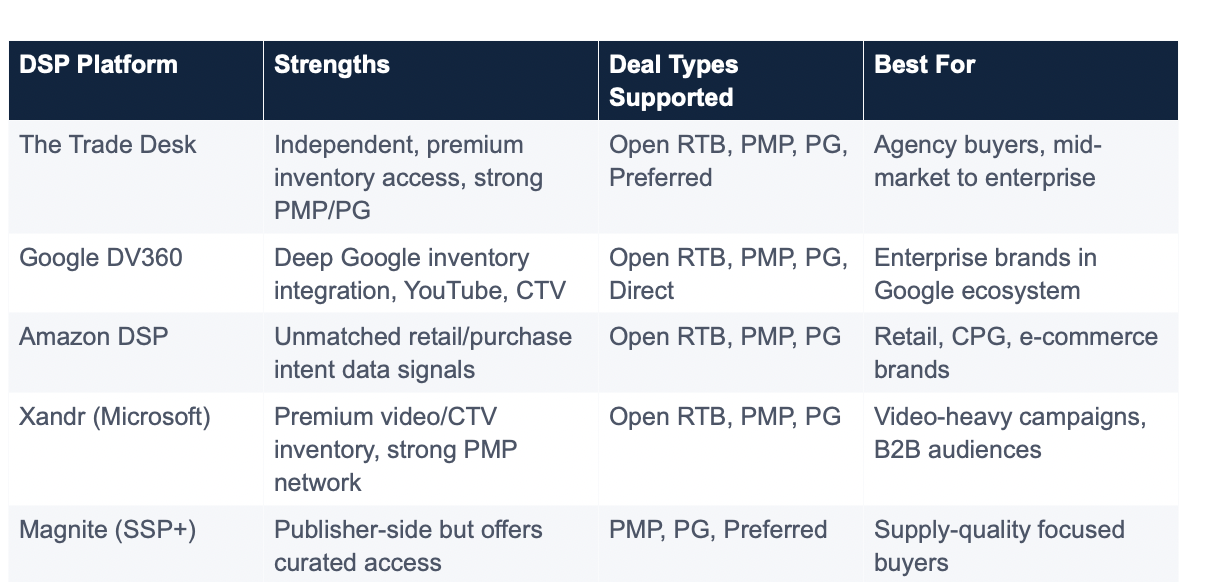
Top DSPs Offering Hybrid Direct + Programmatic Capabilities
For agency strategists and enterprise buyers seeking platforms that support both open auction and programmatic direct/guaranteed deal structures within a single interface:
Frequently Asked Questions: Programmatic vs. Non-Programmatic Advertising
Q: What is the difference between programmatic and non-programmatic advertising?
The core difference is automation versus human execution. Programmatic advertising uses AI and algorithms to buy digital ad inventory in real time matching audiences, setting bids, and serving creatives without manual intervention. Non-programmatic advertising requires human negotiation, manual contracts (insertion orders), and pre-scheduled placements across digital or traditional media. Based on industry standards, programmatic offers superior scalability and audience precision, while non-programmatic provides greater certainty of placement and editorial control.
Q: What is an example of non-programmatic advertising?
A brand negotiating directly with a premium publisher to buy a full-page print ad in a magazine for a fixed fee is the classic example. In digital form, non-programmatic looks like a media buyer emailing a news website to secure a homepage banner ad for 30 days at a fixed CPM executing the deal via a signed insertion order (IO) with no automated auction involved. TV sponsorships, radio spots, and out-of-home billboard bookings are all non-programmatic. These methods prioritise placement certainty and editorial context over audience targeting precision.
Q: What is programmatic advertising vs. direct buying?
Programmatic advertising relies on automated software and real-time bidding on open ad exchanges or private marketplaces to purchase impressions one at a time. Direct buying bypasses auctions entirely: the advertiser (or their agency) negotiates directly with a publisher for a specific placement, audience, time period, and price. Direct buying guarantees placement and pricing certainty, while programmatic offers dynamic pricing and sophisticated audience targeting. The choice typically comes down to whether your campaign prioritises guaranteed premium placement (direct) or algorithmic efficiency and scale (programmatic).
Q: Is Google Ads programmatic or non-programmatic?
Google Ads is a programmatic platform. It uses automated algorithms, real-time bidding, and auction mechanisms to place ads across Google Search, YouTube, and the Google Display Network — without advertisers manually negotiating with individual website publishers. However, Google Ads is a closed programmatic ecosystem (a 'walled garden') rather than an open programmatic exchange. An open programmatic strategy via a DSP like The Trade Desk or DV360 reaches inventory across thousands of publishers outside Google's properties, offering broader reach than Google Ads alone.
Q: What are the disadvantages of programmatic advertising?
The primary disadvantages are: (1) Brand safety risk — without active verification tools, ads can appear next to inappropriate content; (2) Ad fraud exposure — open exchanges carry invalid traffic (bot fraud) risk that requires third-party filtering tools to mitigate; (3) The 'ad tech tax' — DSP, SSP, data, and verification fees mean 30–40% of gross spend may not reach a publisher impression; (4) Complexity — the technology requires trained personnel or agency partners to manage effectively; (5) Algorithm dependency — underbudgeted campaigns fail to generate sufficient data for machine learning optimisation. These disadvantages are manageable with proper governance but are material costs to factor into campaign planning.
Q: Why is programmatic advertising so expensive?
Programmatic advertising can feel expensive because its total cost includes multiple technology layers beyond the raw media price: DSP platform fees (10–15%), SSP/exchange fees (5–10%), third-party audience data licensing (5–15%), and brand safety verification tools (2–5%). Additionally, highly competitive audience segments — affluent consumers, purchase-intent signals, specific professional demographics — drive up dynamic CPMs in real-time auctions. The key is to evaluate programmatic on effective CPM (eCPM) and cost-per-result rather than headline rates. Properly optimised programmatic campaigns typically outperform traditional media on ROI for performance objectives, making them a highly effective way to Grow Your Online Sales, even accounting for the technology cost stack.
Q: What is the difference between programmatic and traditional media buying?
Traditional media buying uses historical audience data, broad demographic profiles, and fixed rate cards to purchase scheduled ad placements on TV, radio, print, or digital direct placements. Programmatic media buying uses real-time user data signals to serve impressions to specific individuals the moment they load a page or stream content. Traditional media buying excels at broad reach, cultural impact, and brand safety certainty. Programmatic excels at audience precision, real-time measurement, and performance efficiency. The most sophisticated media plans use both — traditional for brand investment, programmatic for performance activation.
Q: What are the three types of programmatic advertising?
The three primary types are: (1) Real-Time Bidding (RTB) — an open, auction-based model where every impression is bid on individually as it becomes available, offering maximum scale and efficiency; (2) Private Marketplace (PMP) — an invitation-only auction model where premium publishers offer curated inventory to a select group of approved buyers, providing brand safety with some of RTB's flexibility; and (3) Programmatic Direct (or Programmatic Guaranteed) — a software-automated deal executed at a pre-negotiated fixed price with reserved impressions, combining programmatic efficiency with the certainty of a traditional direct buy. Understanding how to deploy each type is the foundation of a mature programmatic media strategy.
Conclusion: It's Not Either/Or, It's Knowing When to Use Each
The framing of 'programmatic vs. non-programmatic' can be misleading. The real strategic question is not which method wins — it is which method, deployed in which context, with which budget allocation, delivers the best outcome for a specific campaign objective.
Programmatic advertising has transformed the efficiency and precision of digital media buying at scale. It has democratised access to cross-publisher reach for businesses that could never afford traditional mass-media campaigns. And it has given marketers a real-time feedback loop that fundamentally changes how campaigns can be managed.
Non-programmatic advertising — whether a direct digital IO with a premium publisher or a regional radio schedule — offers something algorithms cannot replicate: editorial certainty, community trust, and the cultural resonance of specific, chosen media environments.
The most effective marketing organisations understand both tools deeply, deploy them with intentionality, and build measurement frameworks that capture the contribution of each. That is the standard of practice this guide is designed to support.
Not sure whether programmatic or direct buying is right for your next campaign? Contact our media buying experts for a free strategy consultation.
Sources & Further Reading
- eMarketer (2025). US Programmatic Digital Display Ad Spending Forecast.
- MAGNA Global (2025). Global Advertising Forecast: 2025–2028.
- ANA / ISBA (2023). Programmatic Media Supply Chain Transparency Study.
- Juniper Research (2023). The Future of Digital Advertising: Ad Fraud Loss Report.
- DoubleVerify (2024). Global Insights Report: Media Quality & Performance.
- IAB (2024). Programmatic Advertising Buying & Selling Guide.
- Google / Ipsos (2024). Contextual vs. Demographic Targeting Effectiveness Study.
- Nielsen (2024). Trust in Advertising: Consumer Sentiment Report.
- Binet, L. & Field, P. (2013). The Long and the Short of It. IPA.
- Media Rating Council (MRC). Invalid Traffic Detection & Filtration Guidelines.
- Forrester Research (2024). The Programmatic Buying Landscape.
.jpg)