
Discover what programmatic display advertising is, how real-time bidding works, and how to use DSPs to lower ad costs and boost ROAS. Benchmarks, examples, and execution steps inside.
Why Programmatic Display Still Matters and Why It Often Underperforms
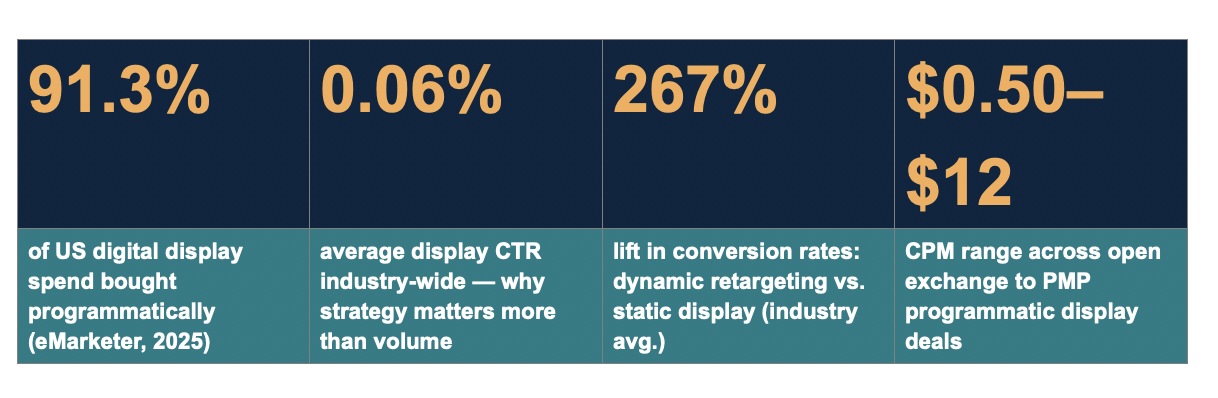
Programmatic display advertising is one of the most widely used tools in digital marketing. In 2025, eMarketer reported that 91.3% of all US digital display ad spend was purchased programmatically. It is, by every measure, the dominant infrastructure for buying digital ad inventory at scale.
And yet it consistently underperforms expectations for a large proportion of the marketers running it.
The reason is not that programmatic display doesn't work. It is that it is frequently deployed without a clear understanding of where it fits in the funnel, what it is genuinely good at, and what it cannot do alone. This guide fixes that. It covers the complete picture: what programmatic display advertising is, how the ecosystem works, what it costs, how to target effectively, and how to build campaigns that deliver measurable results.
Competitive Edge vs. Strategus: Unlike guides that frame programmatic display purely as a CTV support layer, this article covers the complete programmatic display ecosystem from first principles through advanced AI bidding for all buyer profiles and budget levels.
What Are Programmatic Display Ads? Core Definitions
Programmatic Display Advertising: The automated, software-driven buying and serving of visual digital ad placements (banners, rich media, responsive units) across publisher websites and apps using real-time bidding, audience data, and algorithmic decision-making to match the right ad to the right user at the right moment.
Display Ad: A visual ad unit static image, animated GIF, HTML5 rich media, or responsive served in designated ad slots on publisher properties. Programmatic display specifically refers to these units being purchased via automated technology, not through manual insertion orders.
Are All Display Ads Programmatic?
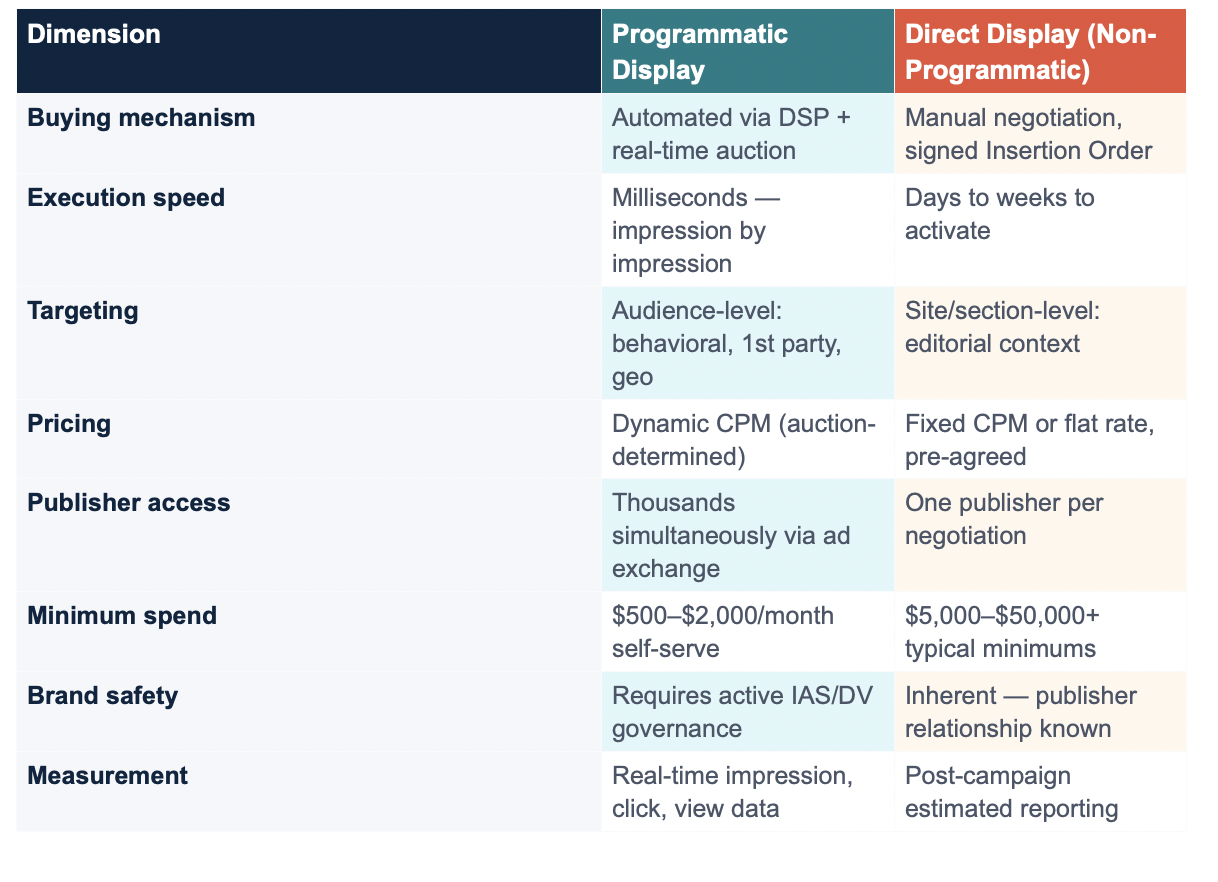
No and this distinction matters operationally. Display advertising describes the format (visual, banner-style placements across publisher sites). Programmatic describes the buying method. A display ad can be bought either way:
How Programmatic Display Fits Into an Omnichannel Strategy?
Programmatic display does not operate in isolation. Its role within a broader omnichannel strategy is best understood as a mid-to-lower funnel reinforcement and retargeting layer not a primary demand creation channel.
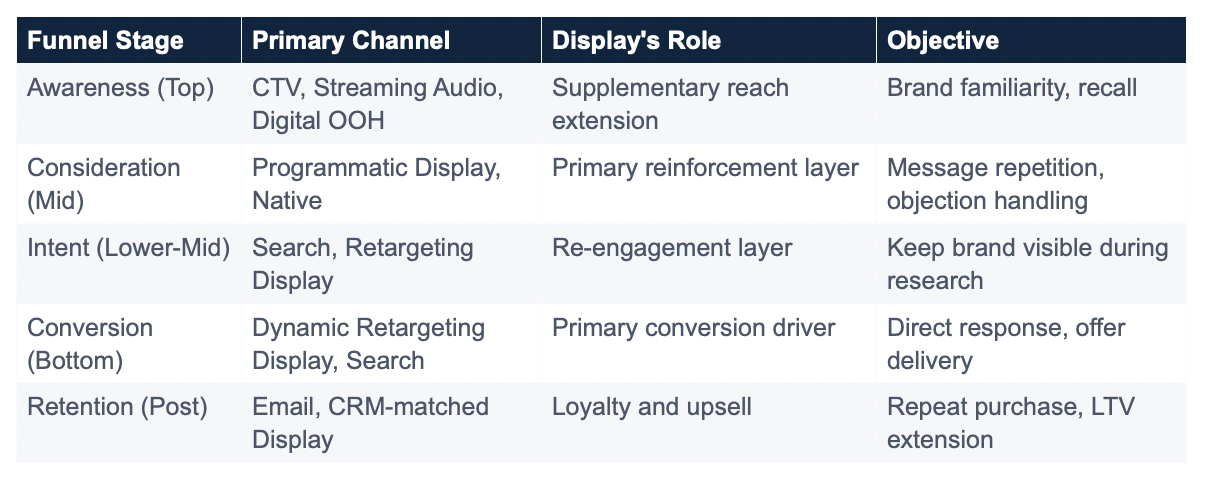
Expert Note: Research from the AMA Baltimore chapter shows that when a CTV ad precedes a programmatic display ad, unaided brand recall increases by up to 125% and purchase intent lifts by 18% versus display alone. Programmatic display performs best when it reinforces, not initiates, campaigns designed to Build Awareness across multiple channels like CTV and out-of-home.
What Makes Programmatic Display Different from Digital Advertising Broadly?
Digital advertising is the umbrella category covering all online marketing: search (SEM/PPC), social media, email, affiliate, and display. Programmatic display advertising is a specific subset the automated buying of graphic, visual ad placements across the open web. It does not include search ads (text-based, keyword-triggered), social feed ads (Facebook, Instagram, TikTok), email marketing, or app store ads. Understanding this scope prevents a very common budget misallocation.
Inside the Ecosystem, How Does Programmatic Display Advertising Work?
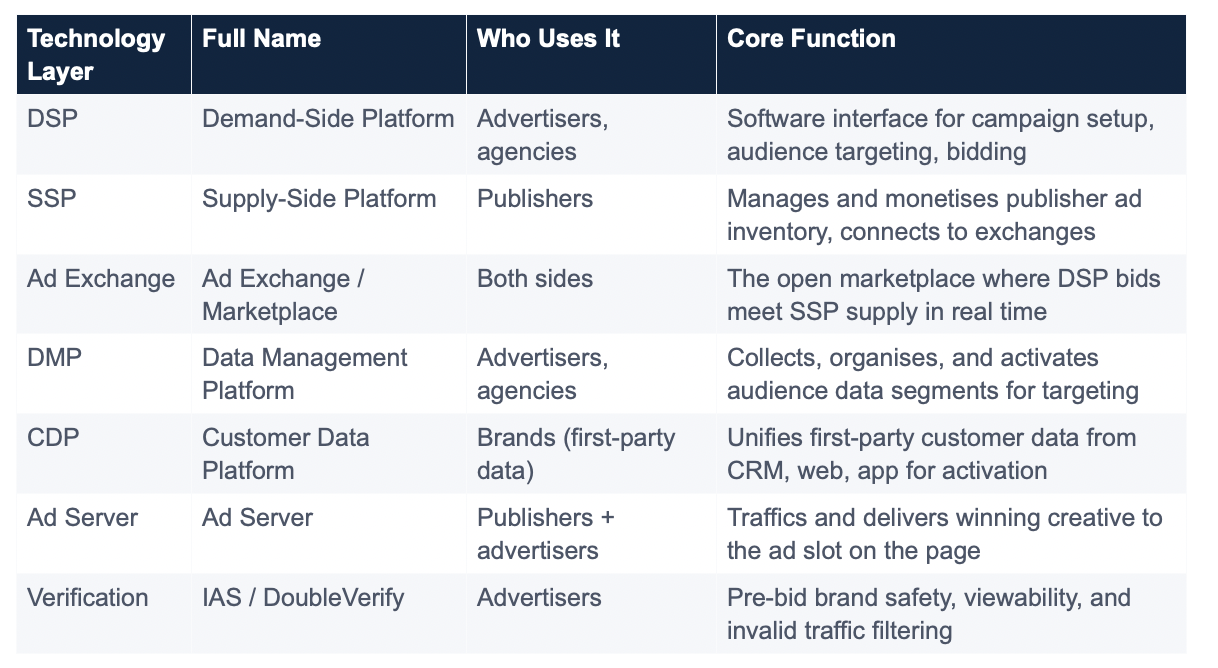
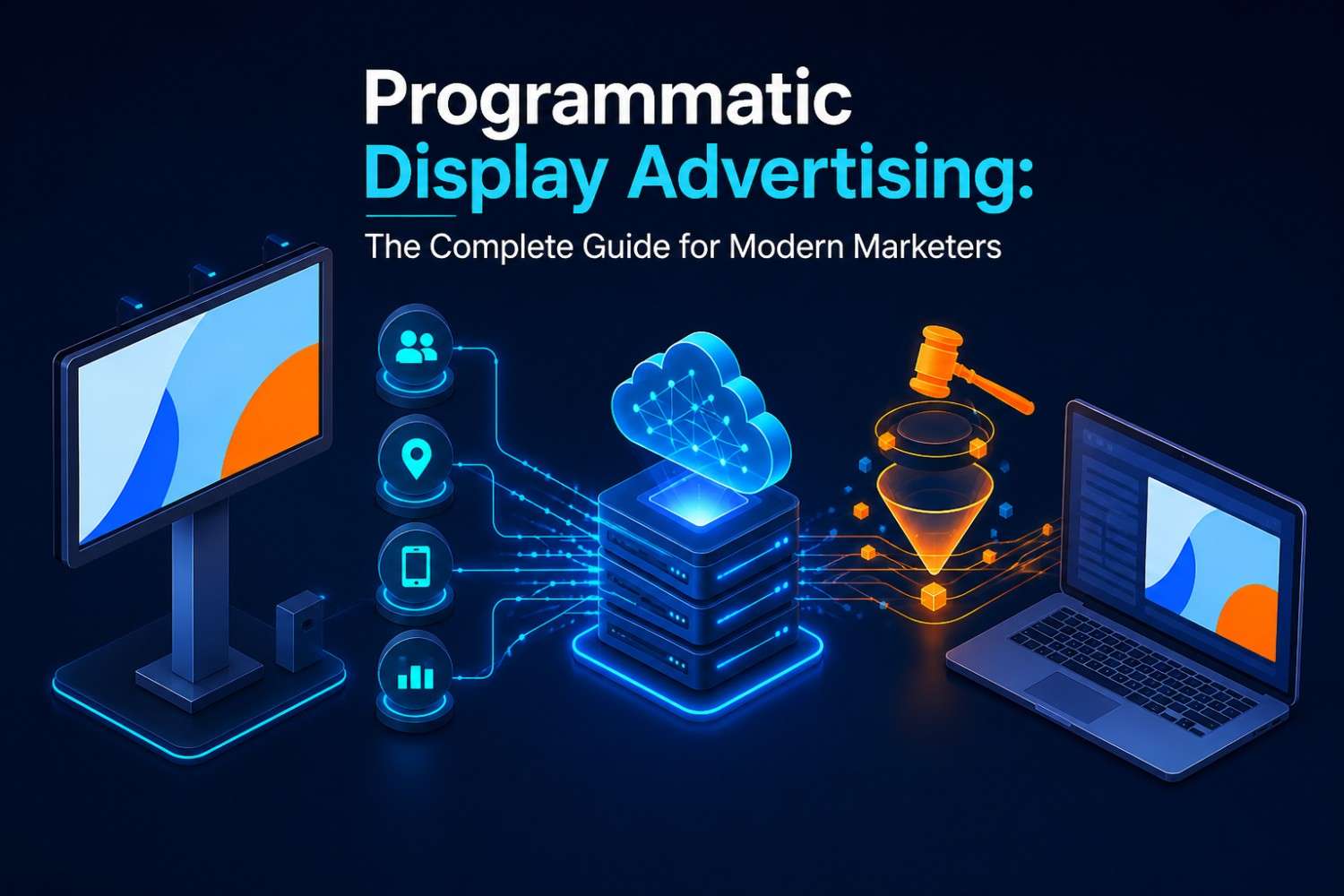
The programmatic display ecosystem involves multiple technology layers, each performing a specific role in the millisecond process of matching an advertiser's bid to a publisher's available impression. Understanding this stack separates strategic buyers from those simply pressing a 'launch' button.
The Core Technology Stack
The Real-Time Bidding (RTB) Process: Step by Step
When a user loads a webpage with a programmatic ad slot, the following sequence fires and completes in under 100 milliseconds before the page content finishes rendering:
- User visits a publisher page. The publisher's ad server detects an available display ad slot.
- The publisher's SSP broadcasts a bid request to connected ad exchanges, including auction parameters: ad dimensions, floor price, page URL, and available audience signals.
- Ad exchanges distribute the bid request simultaneously to all connected DSPs.
- Each DSP evaluates the request against active campaigns: Does this impression match any campaign's audience, contextual, or geographic targeting criteria? If yes, the DSP calculates a bid value.
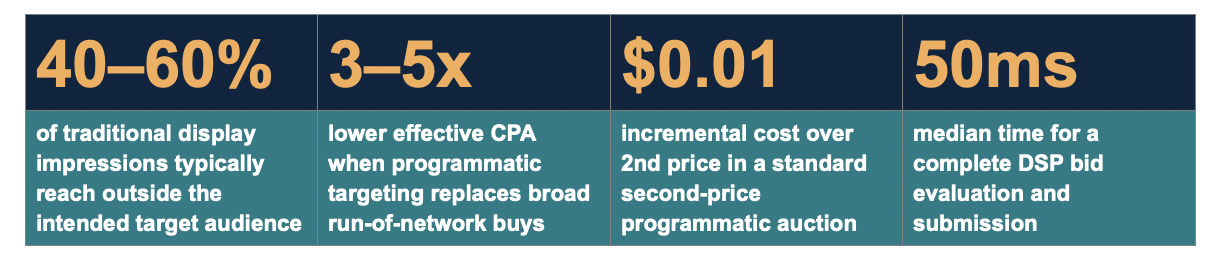
- Qualifying DSPs submit bids (CPM values) to the exchange. In a standard second-price auction, the highest bidder wins but pays the second-highest bid price plus $0.01.
- The winning DSP's ad creative is returned to the SSP, passed to the publisher's ad server, and rendered in the ad slot — all within the page load window.
- Post-impression performance data (viewability, click, conversion) flows back to the DSP, feeding the machine learning algorithm for future bid optimisation.
The Difference Between an Ad Exchange and a DSP
This is one of the most frequently searched questions in the programmatic space and the confusion is understandable because the terms are often used loosely.
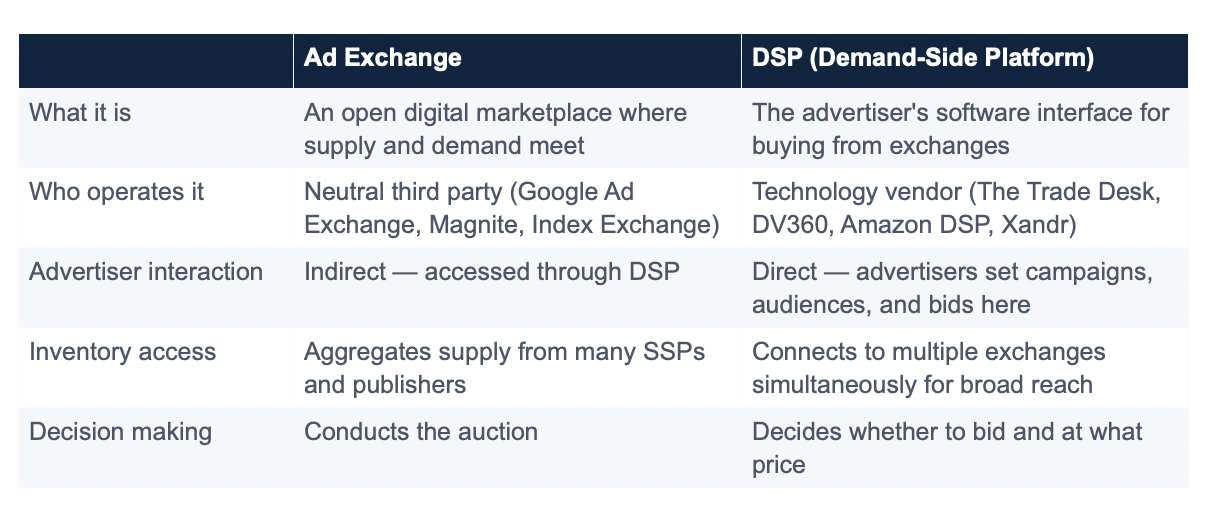
In simple terms: the Ad Exchange is the stock market. The DSP is your broker. You tell your broker what you want to buy and at what price; the broker executes your trades in the marketplace.
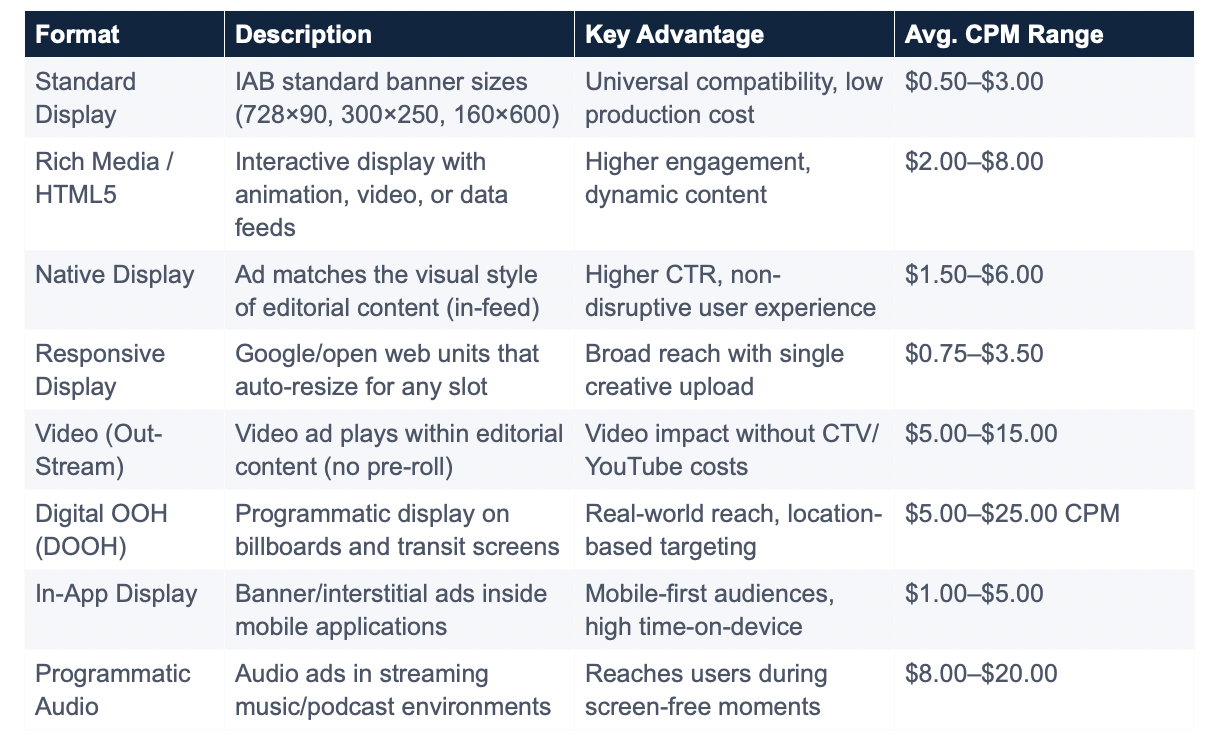
Emerging Programmatic Display Formats Beyond Banner Ads
Programmatic buying has expanded far beyond the classic 728×90 leaderboard or 300×250 rectangle. In 2026, the programmatic ecosystem supports a wide range of display-adjacent and adjacent formats:
As third-party data deprecates, advertisers are also increasingly turning to first-party data ecosystems like Retail Media networks to reach high-intent shoppers natively.
Strategic Benefits, Why Shift to Programmatic Display?
How Programmatic Bidding Reduces Costs While Increasing Impressions
The efficiency argument for programmatic display rests on one core mechanism: algorithmic impression selection. Traditional display buying purchases containers a website, a section, a time slot. You pay for all impressions in that container, regardless of whether the specific user viewing the ad matches your target audience.
Programmatic buying evaluates every individual impression before purchasing it. The DSP's algorithm asks: 'Does this specific user, on this specific page, at this specific moment, match our campaign's targeting criteria?' If yes, it bids. If no, it passes. This means budget flows only to impressions with genuine audience relevance.
Dynamic Retargeting: Why It Outperforms Static Display
Standard programmatic display targets users by audience segment. Dynamic retargeting takes this further by serving personalised ad creatives that reflect exactly what a specific user viewed on your website , a product page, a pricing tier, a specific service, creating immediate, individual relevance.
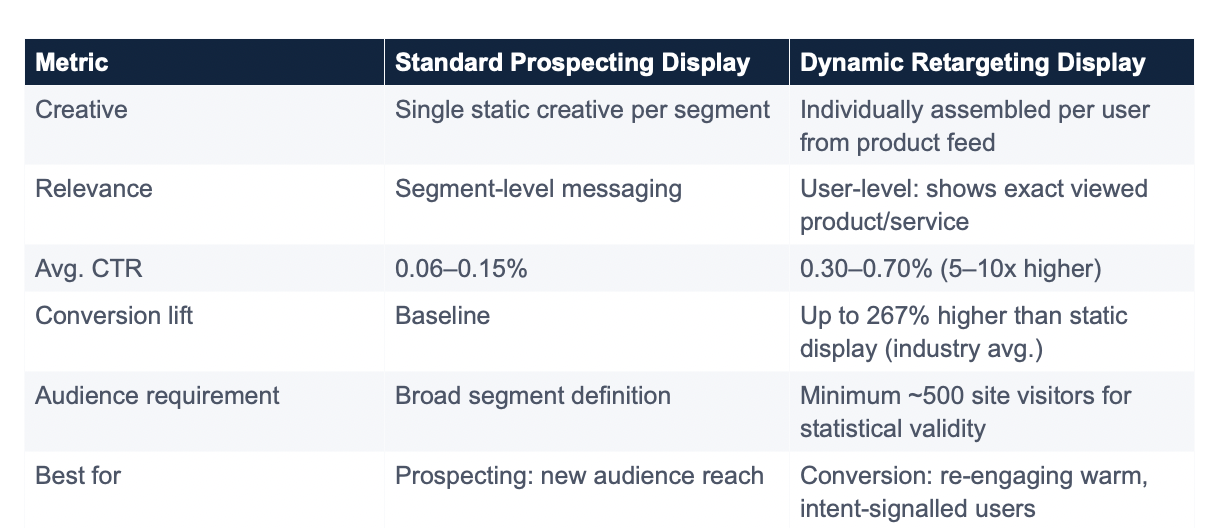
Best Practice: Dynamic retargeting requires a properly implemented product feed (for e-commerce) or page-level pixel taxonomy (for lead-gen/B2B). For B2B marketing teams looking to Generate Qualified Leads, a properly implemented page-level pixel taxonomy is an absolute requirement for the algorithm to work effectively. The quality of your feed data directly determines the quality of the dynamically assembled creative. Garbage in, garbage out.
Benefits for SMBs and Local Businesses: Accessible Premium Inventory
One of the least-appreciated shifts in programmatic display over the past five years is the democratisation of premium inventory access. Previously, a regional retail business could not afford a homepage placement on a national news site minimum buys were prohibitively high. Programmatic changes this equation completely.
Hyper-local targeting: Programmatic DSPs support radius-based, zip code-level, and even store visit attribution targeting. A plumber in Leeds, a restaurant in Dubai Marina, or a dental clinic in Houston can reach specifically the households within their catchment area - and only those households.
Premium inventory, scaled down: Because programmatic buys are executed impression-by-impression, a small business with a $2,000/month budget can appear on premium publisher inventory (major news sites, weather apps, sports properties) without committing to a six-figure direct deal.
Elimination of manual RFP/IO processes: The time cost of traditional advertising — writing RFPs, waiting for media kits, negotiating rates, trafficking creatives - is eliminated entirely. A self-serve DSP campaign can be live in hours.
Measurable ROI from day one: Unlike traditional media where impact is inferred, programmatic display produces impression, click, view-through, and conversion data in real time - enabling genuine cost-per-result calculations even at modest budget levels.
Advanced Targeting, Benchmarks & Measuring Success
The Full Targeting Toolkit: From Broad to Precision
The targeting capabilities available through a modern DSP represent programmatic display's most significant competitive advantage over any form of traditional or manual media buying. Here is the complete taxonomy:
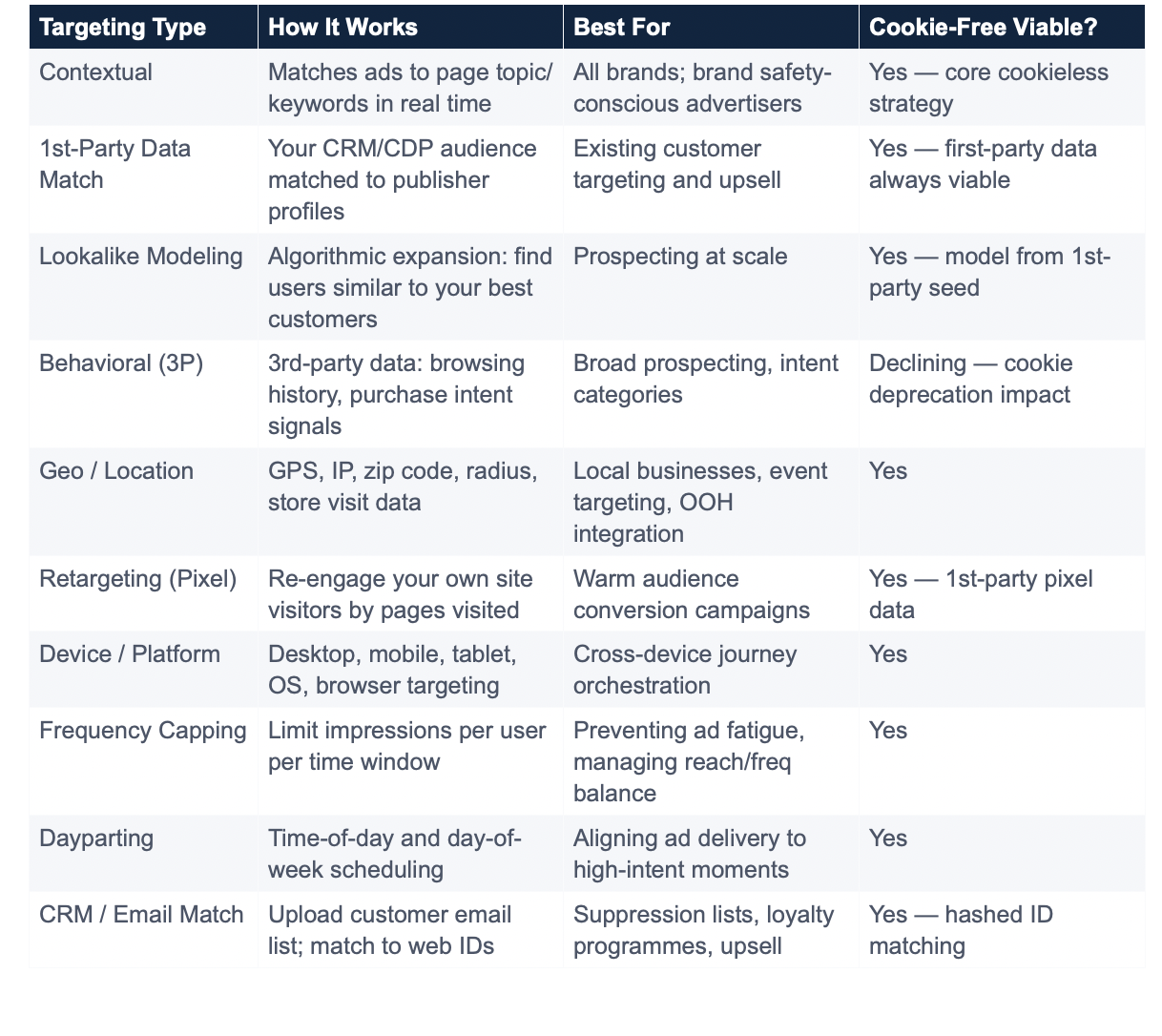
The Cookieless Transition: Google's deprecation of third-party cookies from Chrome (now progressing through 2025–2026) is restructuring programmatic targeting. Advertisers who have invested in clean first-party data, CDPs, and contextual targeting are insulated. Those relying exclusively on third-party data segments are exposed. Industry guidance from the IAB recommends a 60/40 split: 60% first-party and contextual targeting, 40% third-party where still available.
CTR Benchmarks: What to Realistically Expect from Programmatic Display
Click-through rate is the most commonly misunderstood metric in display advertising. Most programmatic display campaigns will generate CTRs that look alarming to marketers accustomed to search advertising's 3–5% click rates. Understanding industry benchmarks by vertical and campaign type is essential for accurate performance evaluation.
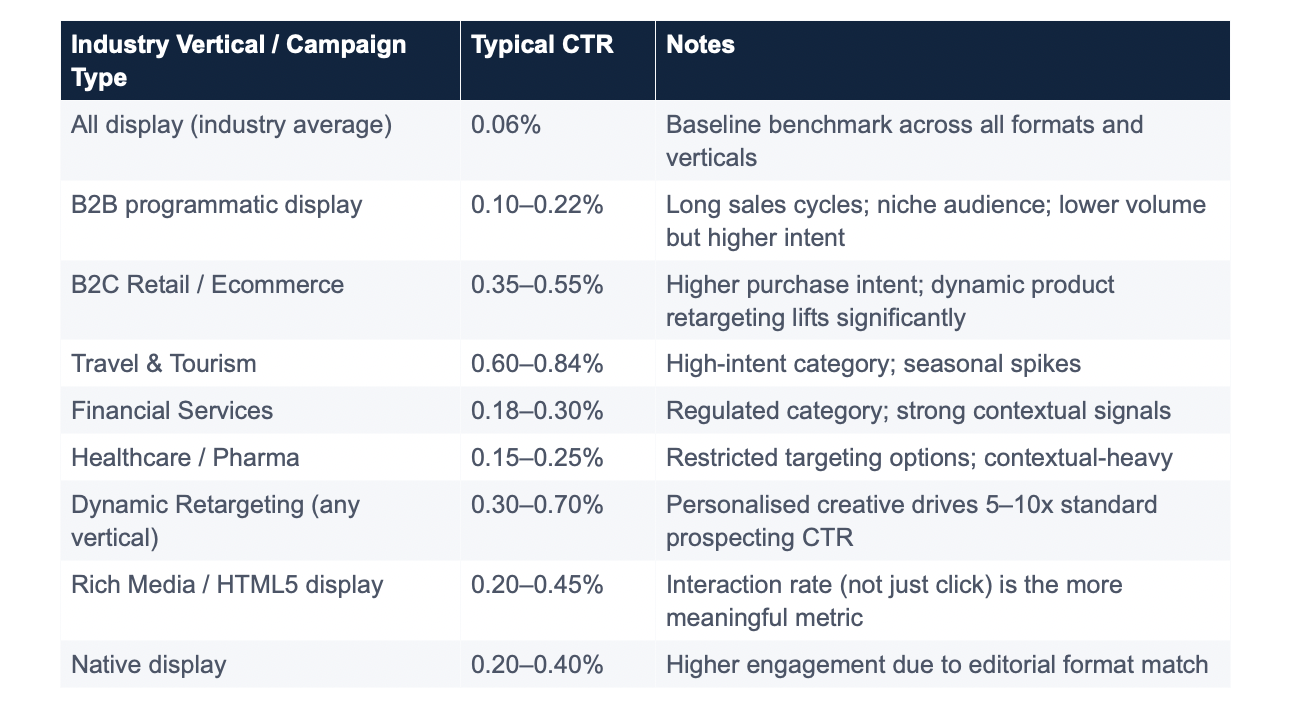
Critical Context: A low CTR does not mean a campaign is failing. Display advertising builds brand recall and purchase intent even when users don't click. However, high-intent vertical campaigns leveraging dynamic retargeting are highly effective tools to Grow Your Online Sales, frequently reaching 0.35–0.84% CTRs. View-through conversions (users who see your ad and later convert without clicking) are frequently 3–5x the volume of click-through conversions. Measuring display on CTR alone is the single most common cause of premature campaign cancellation.
The Right Metrics: ROAS, Viewability, and Beyond Last-Click
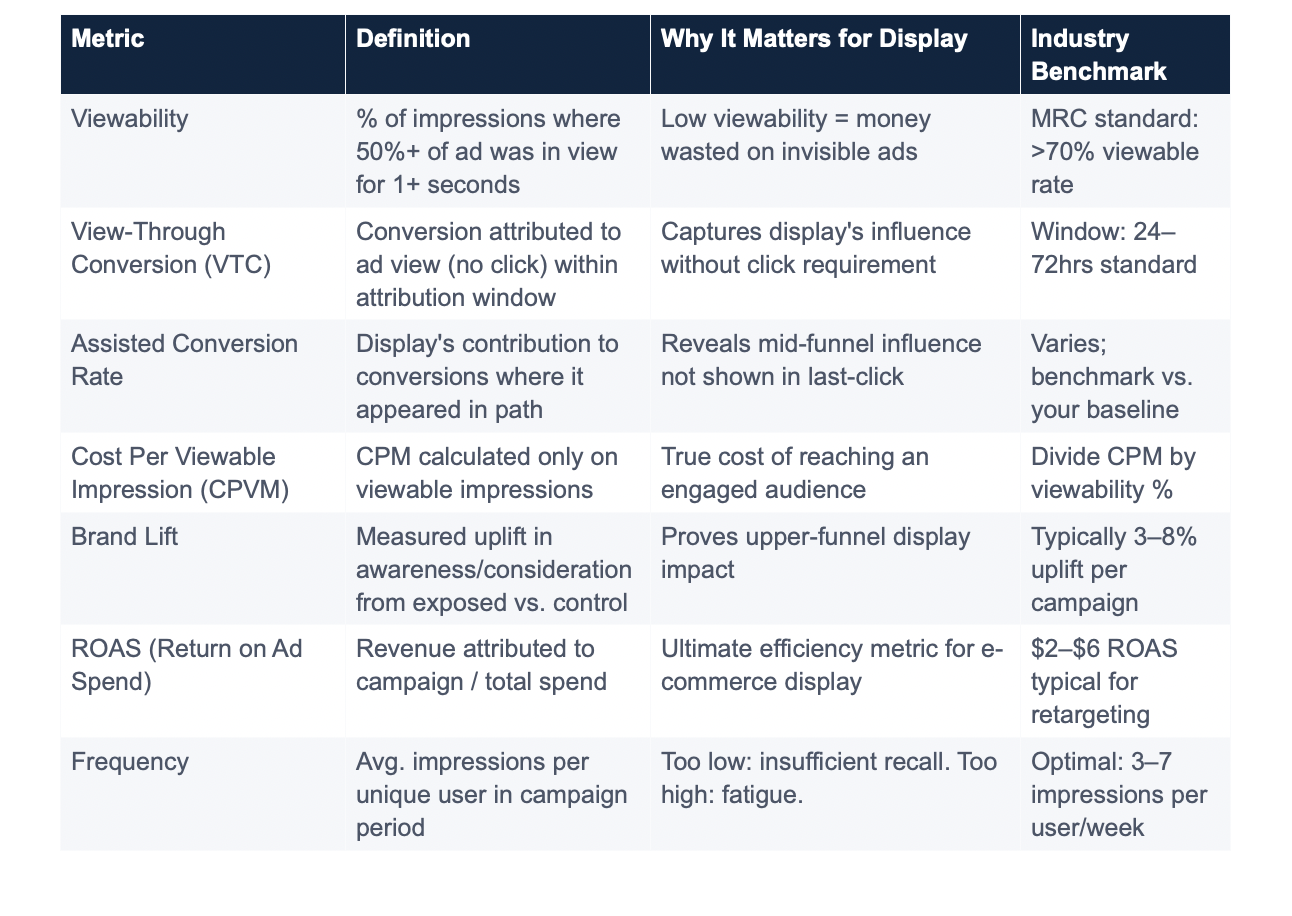
Programmatic display campaigns should be evaluated on a measurement framework that reflects the full contribution of display to the buyer journey not just the final click.
Executing Your Campaign: Budgets, Platforms & Next Steps
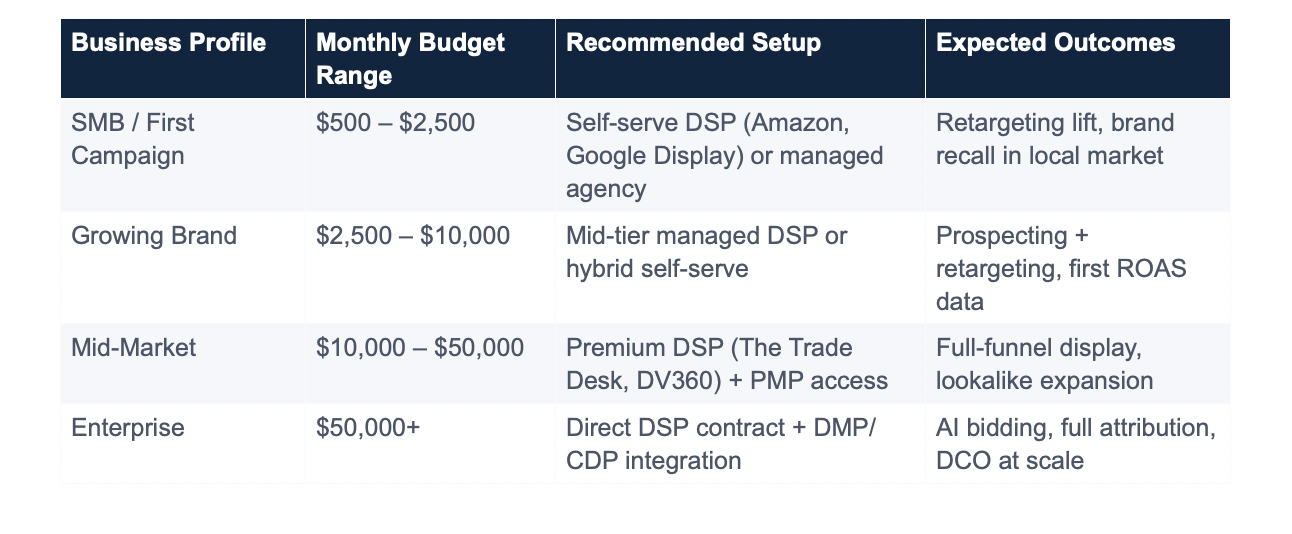
How Much Does Programmatic Display Advertising Cost to Get Started?
The entry barriers to programmatic display have fallen dramatically over the past five years. Understanding the cost structure upfront prevents the two most common budget mistakes: underfunding the algorithm, and misallocating budget across tech layers.
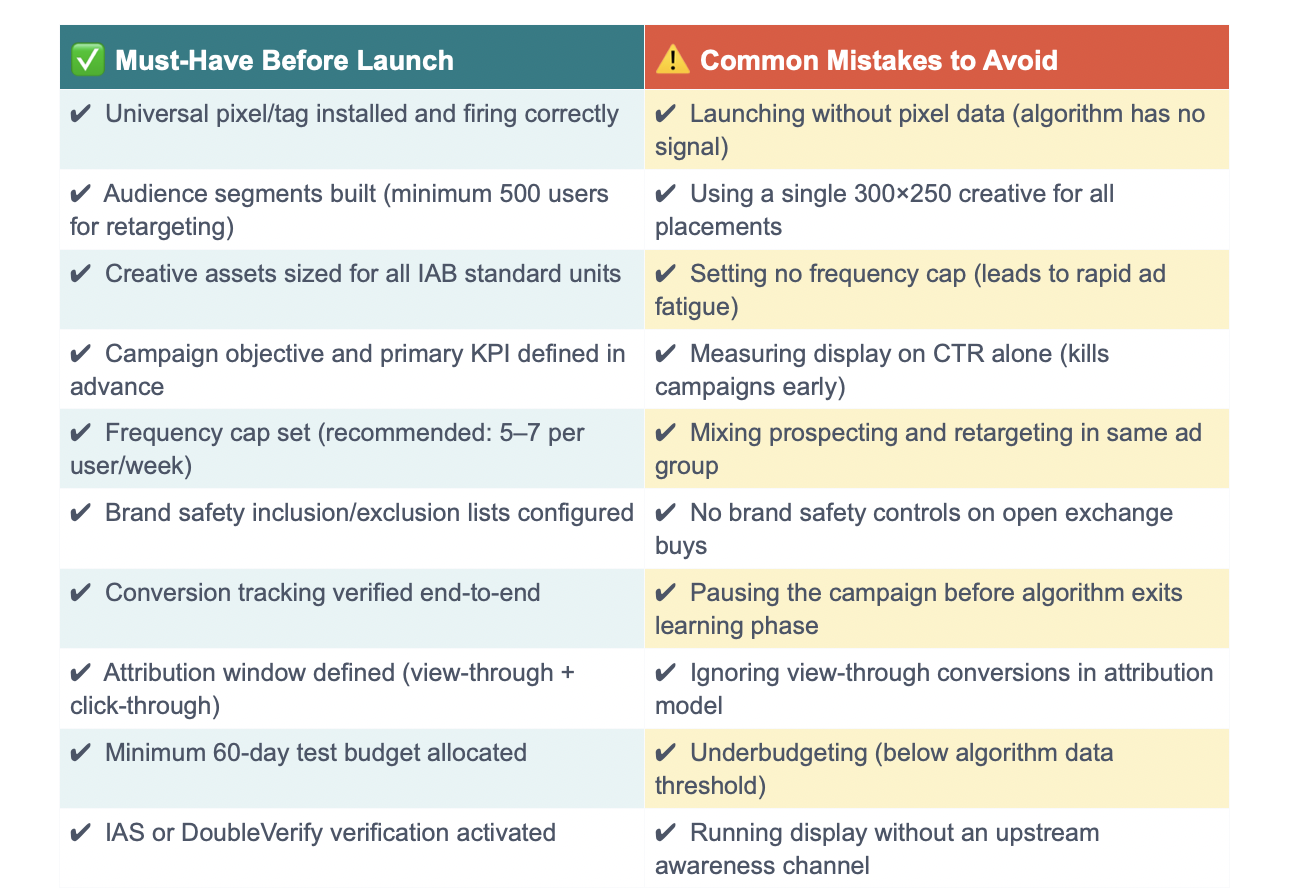
Launch Checklist: First Programmatic Display Campaign
Before clicking 'launch', every campaign regardless of budget level should complete this pre-flight checklist:
AI-Based Bid Strategies: Choosing the Right Algorithm
Modern DSPs offer multiple automated bidding strategies, each optimising toward a different objective. Selecting the wrong bid strategy is one of the most impactful and most overlooked campaign decisions.
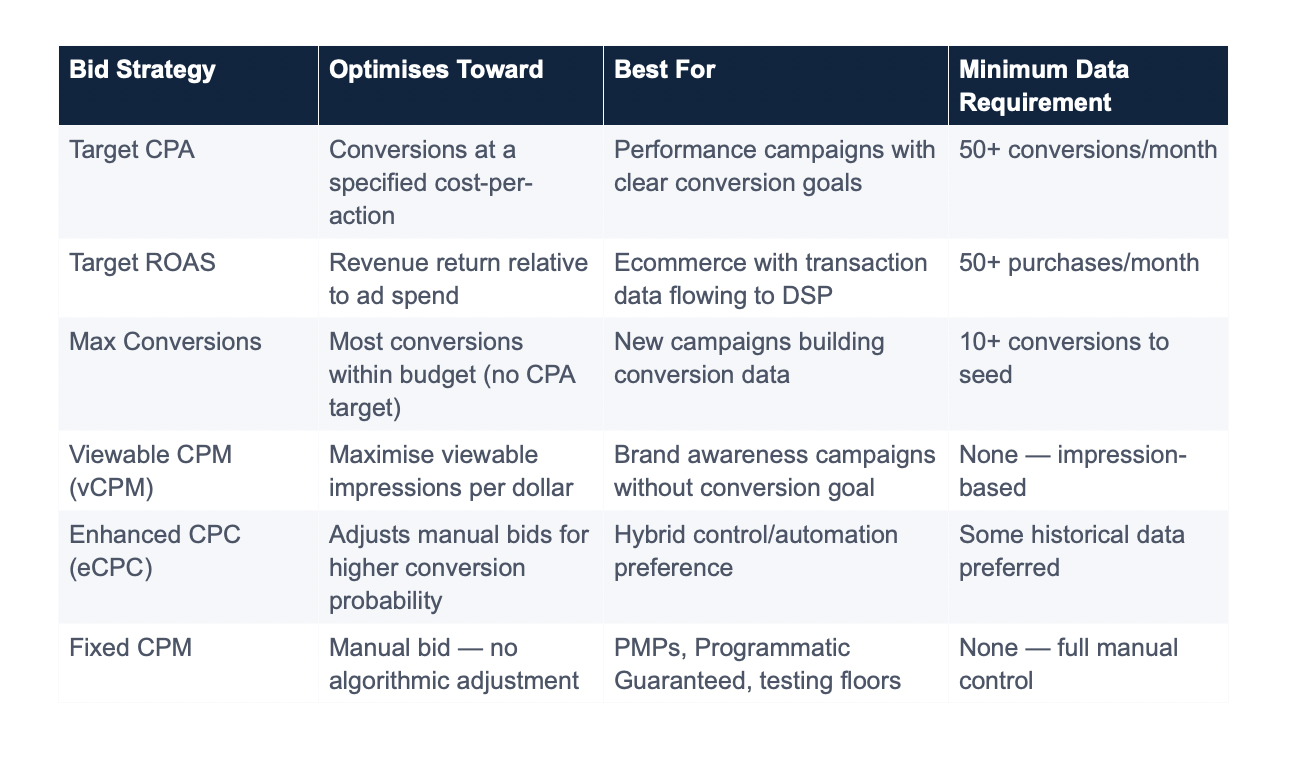
Algorithm Learning Phase: All automated bid strategies require a learning phase during which the algorithm collects conversion signals before optimising effectively. The Google/DV360 threshold is typically 50 conversion events within a 30-day window. The Trade Desk recommends 30+ conversions per flight before evaluating CPA-based bidding performance. Campaigns that are paused or restructured before reaching this threshold will consistently underperform.
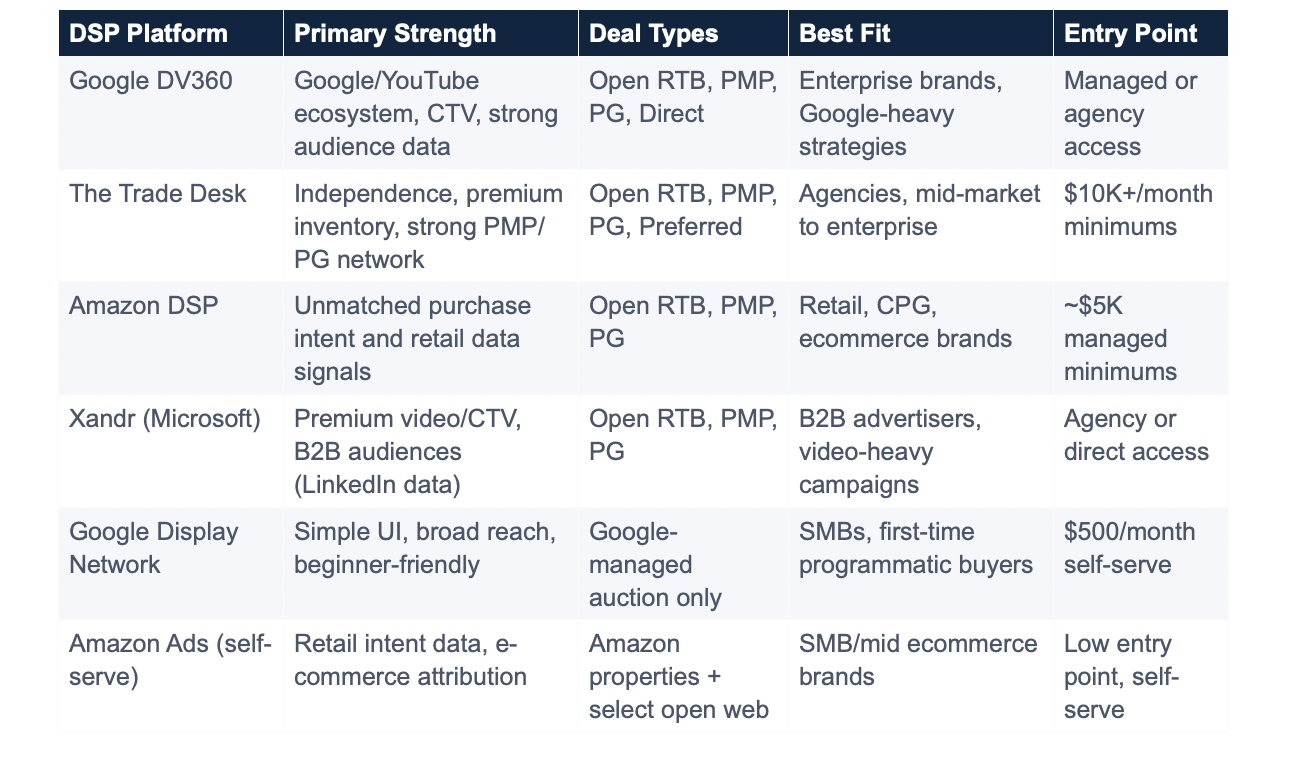
Choosing the Right DSP: In-House vs. Agency
Before committing to a specific software or agency, reviewing the Best Programmatic Advertising Platforms can help you align the technology with your actual budget and operational capacity.
Frequently Asked Questions: Programmatic Display Advertising
Q: What is the difference between an ad exchange and a DSP?
A Demand-Side Platform (DSP) is the software interface advertisers and agencies use to set up campaigns, define target audiences, and manage bidding strategies. An ad exchange is the open digital marketplace where the DSP connects with publisher supply (via SSPs) to facilitate the actual real-time auction transaction. You need a DSP to access ad exchange inventory effectively the exchange is the marketplace, the DSP is your automated buying agent operating within it. Most leading DSPs (The Trade Desk, DV360, Xandr) connect to multiple ad exchanges simultaneously, giving advertisers access to billions of daily impressions across thousands of publishers from a single interface.
Q: What makes dynamic retargeting more effective than traditional display ads?
Dynamic retargeting serves individually assembled ad creatives featuring the specific products or services a user previously viewed on your website creating immediate, personal relevance. This contrasts with standard display ads which serve the same static creative to an entire audience segment. Industry data consistently shows dynamic retargeting delivers conversion rate lifts of up to 267% compared to static display advertising. The mechanism is simple: a user who viewed your pricing page or specific product is far more likely to respond to an ad showing exactly that item than to a generic brand message. Effective dynamic retargeting requires a properly configured product feed or page-level pixel taxonomy, and a minimum audience pool of approximately 500 users to generate statistically valid personalisation.
Q: What types of advertisements are available with programmatic?
Programmatic buying supports a comprehensive range of ad formats well beyond the classic banner ad. The main categories are: standard display (IAB banner sizes 728×90, 300×250, 160×600), rich media/HTML5 (interactive, animated, or data-driven units), native display (ads matched to the editorial look and feel of the surrounding content), responsive display (auto-resizing units adapting to any available ad slot), out-stream video (video ads playing within editorial content), Digital Out-of-Home (DOOH — programmatic buying of digital billboard and transit screen placements), in-app mobile display, and programmatic audio. The ability to manage all these formats from a single DSP interface is one of programmatic's core efficiency advantages for cross-channel campaigns.
Q: How does programmatic bidding reduce costs while increasing impressions?
Programmatic bidding reduces wasted spend by evaluating every individual impression before purchasing it asking algorithmically whether the specific user loading that specific page matches the campaign's target audience criteria. Traditional media buys pay for all impressions in a purchased container (a website, a section, a time slot) regardless of audience relevance. By passing on impressions that don't match targeting criteria, programmatic allocates budget exclusively to relevant exposures. Combined with real-time second-price auction mechanics (where winners pay just above the second-highest bid, not their maximum), well-optimised programmatic campaigns routinely achieve 3–5x lower effective CPA than comparable run-of-network buys.
Q: What are realistic CTR benchmarks for B2B versus B2C display campaigns?
B2B programmatic display campaigns typically average 0.10–0.22% CTR, reflecting longer decision cycles, niche professional audiences, and lower impulse-purchase behaviour. B2C campaigns in high-intent verticals such as travel, retail, and ecommerce frequently reach 0.35–0.84% CTR — with dynamic retargeting campaigns reaching 0.30–0.70% across all verticals. The industry-wide average across all display formats and verticals is approximately 0.06% as of 2025. Critically: CTR is not the primary success metric for most display campaigns. View-through conversions (conversions following ad exposure without a click) frequently represent 3–5x the volume of click-through conversions. Always benchmark your campaign against your specific vertical rather than global averages.
Q: Are all display ads programmatic?
No. Display advertising describes the format visual banner-style placements on publisher properties. Programmatic describes the buying method. A display ad can be purchased via a programmatic auction (automated, real-time) or via a direct insertion order (IO) negotiated manually with a publisher. In 2025, approximately 91% of US digital display spend is bought programmatically, making programmatic the dominant buying method. But a meaningful portion of high-impact, premium placements — homepage takeovers, branded editorial integrations, sponsored site sections — are still purchased via direct IOs due to their guaranteed placement and editorial customisation requirements.
Q: What is the difference between digital advertising and programmatic display advertising?
Digital advertising is the broad umbrella category covering all paid online marketing: search advertising (Google Ads, Bing), social media advertising (Meta, TikTok, LinkedIn), email marketing, affiliate marketing, influencer partnerships, and display advertising. Programmatic display advertising is a specific, defined subset: the automated, algorithmic buying of visual display ad placements (banners, rich media, native, video, DOOH) across publisher websites and apps via real-time auctions and DSP technology. It excludes search ads (text-based, keyword-triggered), social feed ads (which use platform-owned closed ecosystems), and email. Understanding this scope prevents the common mistake of allocating display budgets to channels where different buying mechanics and metrics apply.
Q: How can targeting options impact conversion rates in display advertising?
Advanced targeting options have a direct and measurable impact on display conversion rates. Industry data shows that first-party data matching and lookalike modeling can yield 142% higher click-through rates compared to broad demographic targeting alone translating directly into lower CPAs and higher ROAS. The impact is amplified by targeting layering: combining contextual targeting (page-level relevance) with behavioral signals (purchase intent data) and frequency capping (preventing overexposure) produces the highest-performing programmatic display configurations. As third-party cookie availability declines, advertisers who have built robust first-party data assets and CDP-to-DSP integration pipelines will maintain this targeting advantage while competitors relying on third-party data segments face degraded performance.
Conclusion: Building a Programmatic Display Strategy That Actually Works
Programmatic display advertising is not magic, and it is not broken. It is a precision instrument that performs in direct proportion to the quality of the strategy, data, and governance applied to it.
The marketers who succeed with programmatic display in 2026 share three characteristics: they use it in the right place in the funnel (reinforcement and retargeting, not cold demand creation); they invest in clean, consented first-party data before third-party cookie signals disappear; and they measure it on the full contribution it makes to the buyer journey not just the last click.
Use this guide as your operational reference from setting up your first retargeting pixel to selecting the right DSP bid strategy for your objective. The tools are more accessible than ever. The competitive advantage now belongs to those who understand them.
Sources & Further Reading
- eMarketer (2025). US Programmatic Digital Display Ad Spending Forecast.
- AI Digital (2025). 2025 Display Advertising CTR Benchmarks Report.
- DoubleVerify (2024). Global Insights Report: Media Quality & Performance.
- IAB Tech Lab (2024). Programmatic Advertising Ecosystem Guide.
- IAB (2024). Cookieless Transition: First-Party Data Readiness Report.
- AMA Baltimore Chapter (2024). Does Ad Exposure Impact Brand Recall? CTV + Display Study.
- Google / Ipsos (2024). Contextual Targeting Effectiveness in Programmatic Display.
- Media Rating Council (MRC). Viewability Standards and IVT Guidelines.
- Juniper Research (2023). Ad Fraud and Verification in Programmatic Ecosystems.
- ANA / ISBA (2023). Programmatic Media Supply Chain Transparency Study.
- The Trade Desk (2024). Intelligence Report: AI Bidding Optimisation Thresholds.
.jpg)