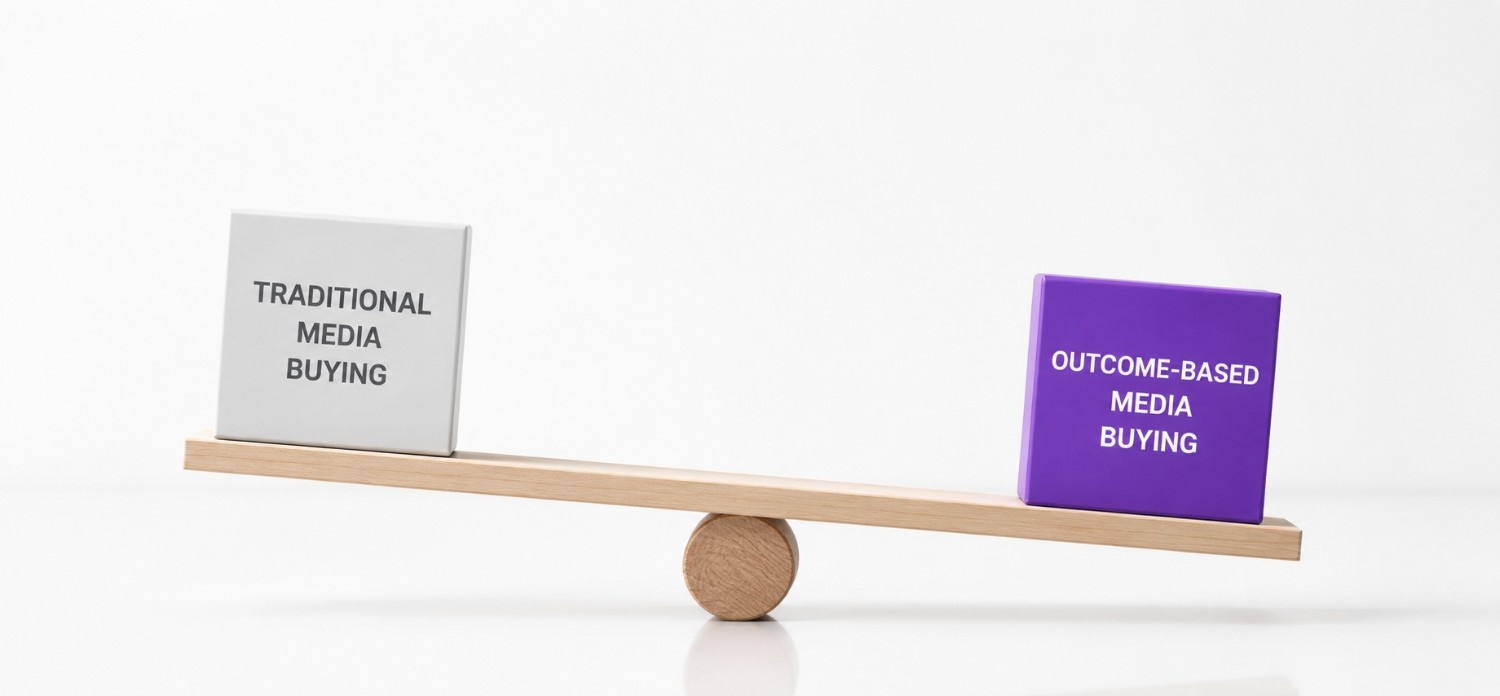
Traditional media buying measures campaign success by media delivery, such as impressions, clicks, reach, or views. Outcome-Based Media Buying measures success by verified business results, such as qualified leads, sales, subscriptions, or revenue.
The difference is not just how campaigns are measured. It fundamentally changes how advertisers invest, optimise, and evaluate marketing performance.
Comparison at a Glance
Why This Difference Matters
Traditional buying answers the question:
Did the campaign run successfully?
Outcome-Based Media Buying answers a different question:
Did the campaign help the business grow?
That distinction is increasingly important because boards, finance teams, and executive leadership evaluate marketing by commercial contribution rather than media efficiency alone.
Outcome-Based Media Buying vs Performance Marketing
Performance Marketing is a campaign optimisation discipline. Outcome-Based Media Buying is a commercial buying model.
Although the two often work together, they are not interchangeable.
Comparison Table
Why This Matters
Many organisations already run successful performance marketing campaigns.
Outcome-Based Media Buying builds on those capabilities by aligning commercial incentives with measurable business success.
Think of Performance Marketing as how campaigns are managed, while Outcome-Based Media Buying defines how partners are compensated and held accountable.
Real-World Examples
Understanding the theory is useful.
Seeing how the model works in practice makes it much easier to evaluate.
1. Banking
Objective :
Increase approved credit card applications.
Traditional Model
The bank purchases impressions and clicks, then measures the number of completed application forms.
Outcome-Based Model
Media partners are compensated only for approved applications that satisfy predefined eligibility criteria.
Business Benefit
Marketing investment becomes directly linked to profitable customer acquisition rather than application volume.
2. Real Estate
Objective
Generate qualified property buyers.
Traditional Model
Campaigns optimise toward lead generation.
Sales teams later determine which enquiries are genuine.
Outcome-Based Model
Media investment is tied to qualified property viewings or verified buyer appointments.
Business Benefit
Budgets increasingly flow toward channels that produce serious buyers rather than enquiry volume.
3. Retail and Ecommerce
Objective
Increase online sales.
Traditional Model
Success is measured using clicks, sessions and conversion rates.
Outcome-Based Model
Commercial agreements reward verified purchases, repeat customers or incremental revenue.
Business Benefit
Optimisation shifts from attracting traffic to acquiring profitable customers.
4. Automotive
Objective
Increase vehicle sales.
Traditional Model
Campaigns optimise toward brochure downloads or lead forms.
Outcome-Based Model
Media partners are rewarded for verified test drives or completed vehicle purchases.
Business Benefit
Sales teams receive higher-quality opportunities while marketing gains clearer accountability.
5. Telecommunications
Objective
Acquire new subscribers.
Traditional Model
Success is measured using lead volume.
Outcome-Based Model
Payment occurs after successful SIM activation or subscription activation.
Business Benefit
Marketing investment aligns directly with customer growth.
6. SaaS
Objective
Acquire long-term subscribers.
Traditional Model
Campaigns optimise toward free trial registrations.
Outcome-Based Model
Media partners are compensated only after customers convert into paying subscribers.
Business Benefit
Budgets favour customer quality instead of trial volume.
7. Common Misconceptions
As Outcome-Based Media Buying gains popularity, several misconceptions continue to circulate.
Understanding these helps organisations adopt the model more effectively.
Misconception 1
Outcome-Based Media Buying is simply another name for CPA.
Reality:
CPA measures one type of conversion.
Outcome-Based Media Buying can measure any commercially valuable business outcome.
Misconception 2
Brand campaigns cannot use outcome-based models.
Reality:
Brand awareness remains important.
Many advertisers now combine brand investment with outcome-based commercial agreements across performance channels.
Misconception 3
Outcome-Based Media Buying eliminates all advertiser risk.
Reality:
Commercial accountability is shared.
Factors such as pricing, product quality, customer experience and sales capability continue to influence business outcomes.
Misconception 4
It only works for ecommerce.
Reality:
Outcome-based models are increasingly used across banking, insurance, healthcare, automotive, education, real estate and telecommunications.
Misconception 5
It requires perfect attribution.
Reality:
No attribution model is perfect.
Successful advertisers focus on transparent, agreed measurement frameworks rather than absolute precision.
Executive Checklist
Before adopting Outcome-Based Media Buying, leadership teams should evaluate the following questions.
Business Objectives
Have we clearly defined the commercial outcome?
Does the outcome represent genuine business value?
Is the objective measurable?
Measurement
Can we verify outcomes independently?
Do we have reliable first-party data?
Are CRM and analytics systems integrated?
Commercial Readiness
Are media partners willing to share accountability?
How will disputes be resolved?
Is the pricing model commercially sustainable?
Organisational Readiness
Are marketing and sales aligned?
Does finance support outcome-based measurement?
Can internal teams report commercial outcomes consistently?
If the answer to most of these questions is "yes," your organisation is well positioned to explore Outcome-Based Media Buying.
Frequently Asked Questions
What is Outcome-Based Media Buying?
Outcome-Based Media Buying is a commercial model where advertisers compensate media partners based on verified business outcomes rather than media delivery metrics such as impressions or clicks.
Is Outcome-Based Media Buying the same as Performance Marketing?
No.
Performance Marketing focuses on campaign optimisation.
Outcome-Based Media Buying defines how media investment and commercial accountability are structured.
Which industries benefit most?
Industries with measurable customer acquisition typically benefit the most.
Examples include:
- Banking
- Retail
- Ecommerce
- Automotive
- Telecommunications
- Healthcare
- Real Estate
- SaaS
Does Outcome-Based Media Buying replace branding?
No. Most organisations combine brand building with outcome-based acquisition strategies.
The two approaches complement rather than replace one another.
What technology is required?
Most advertisers rely on:
- CRM platforms
- Analytics tools
- First-party customer data
- Attribution systems
- Marketing automation
- Offline conversion tracking
Is this only for enterprise organisations?
No. Although large enterprises often have more sophisticated measurement capabilities, many mid-sized businesses can also adopt outcome-based commercial models with the right measurement framework.
.jpg)