
Introduction
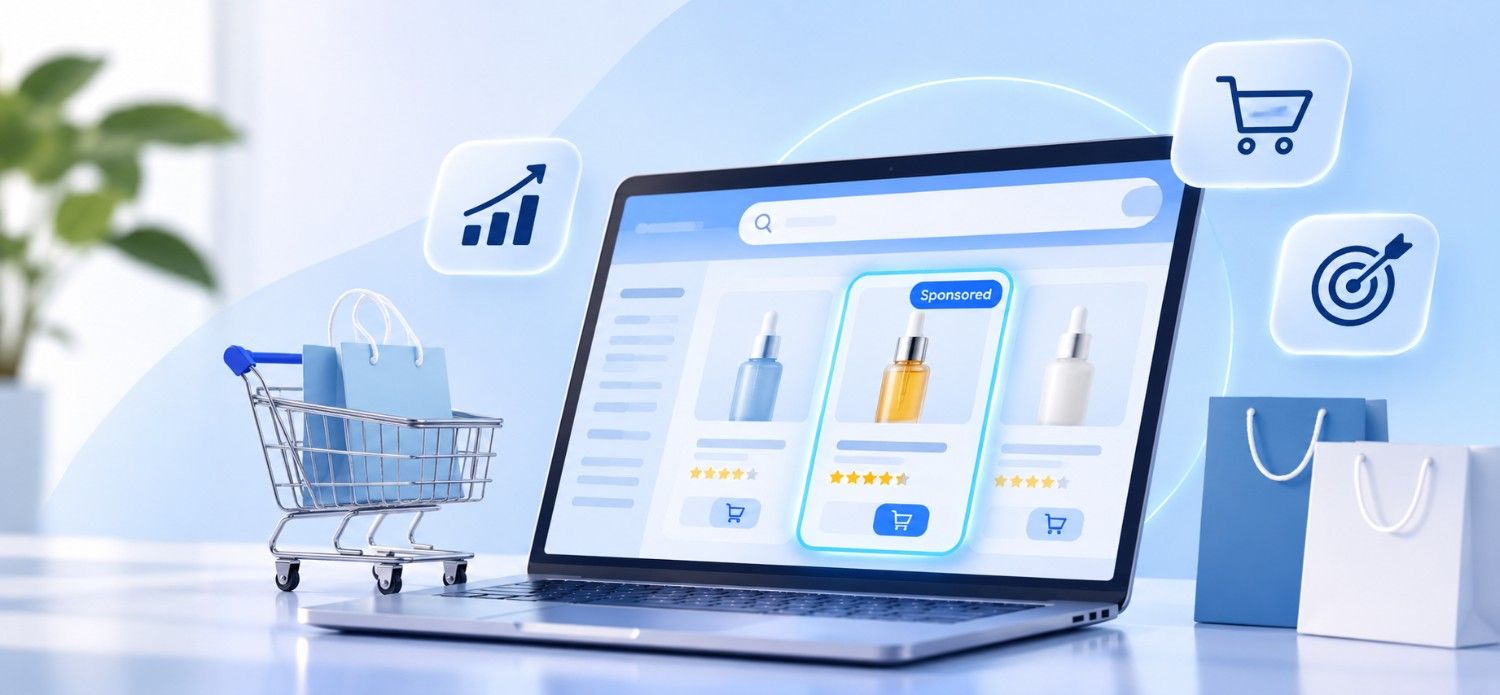
Sponsored product advertising is a retail media format that promotes individual products inside a retailer’s digital shopping environment. These ads can appear in search results, category pages and product detail pages, reaching shoppers while they are actively browsing, comparing products or preparing to buy.
That proximity to purchase is what makes sponsored product ads a foundational retail media format. They help brands increase product visibility, drive qualified traffic to product detail pages and connect advertising spend to measurable outcomes such as conversions and return on ad spend (ROAS).
For brands operating in the UAE and Saudi Arabia, retail media can also provide access to verified shoppers across leading retail environments.
This guide explains how sponsored product advertising works, where ads appear, how to build and optimise campaigns, and which metrics matter most.
Ready to reach shoppers when they are ready to buy? Discover how the Radius Retail Media Advertising Platform helps brands reach high-intent shoppers and drive more conversions.
What Is Sponsored Product Advertising?
Sponsored product advertising is a paid retail media format that increases the visibility of individual products within a retailer’s website or app. The retailer’s advertising platform, often called a retail media network (RMN), sells these placements to brands.
Sponsored product ads typically use information already available in a product catalogue, such as the product image, title, price, rating and availability. They resemble organic product listings, but carry a “Sponsored” label to distinguish paid placements from unpaid results.
Unlike display advertising placed around a page, sponsored product ads appear within the shopping experience itself.
For example, a shopper searches for “vitamin C serum.” A relevant sponsored product may appear near the top of the results, showing its image, price and rating. When the shopper clicks, they land on the product detail page (PDP), where they can review the product and make a purchase.
This format is designed to connect product discovery with the next step in the shopping journey.
How Sponsored Product Ads Work
A sponsored product campaign generally follows a sequence of steps:
- Product selection: The brand chooses the products or SKUs (stock keeping units) it wants to promote.
- Campaign setup: The advertiser sets targeting, a budget and bids.
- Ad matching and auction: The platform evaluates the product, targeting and auction conditions to determine whether and where the ad appears.
- Ad placement: The sponsored listing appears in a relevant shopping environment.
- Product page visit: The shopper clicks through to the product detail page.
- Conversion: The shopper may complete a purchase.
- Reporting: Attributed sales are compared with advertising spend.
Many sponsored product formats use a cost-per-click (CPC) model. The advertiser pays when a shopper clicks, rather than simply when the ad is shown. The specific pricing, targeting and auction mechanics vary by retailer and platform. Amazon Ads, for example, describes Sponsored Products as CPC ads that promote individual product listings and direct shoppers to the product detail page.
With Platformance, RADIUS retail media network brings planning and activation together across retail and media environments. Brands can plan onsite and offsite activity through one booking order and review performance through unified reporting.=
Where Sponsored Product Ads Appear
Sponsored product ads are most commonly associated with onsite retail media placements: advertising within a retailer’s own website or app.
Onsite placements
- Search results pages: Reach shoppers actively searching for a product or category.
- Category pages: Build visibility as shoppers browse a broader product range.
- Product detail pages: Appear while shoppers compare products or consider alternatives.
- Recommendation carousels: Promote relevant or complementary products.
- Homepage placements: Support discovery where the retailer offers this inventory.
Offsite retail media
Retail media can also extend beyond a retailer’s own properties. Depending on the network and campaign objective, offsite activity may include display, video, connected TV (CTV), the open internet and closed platforms such as Meta and Google.
These placements can support prospecting and retargeting, while onsite sponsored products are often used to capture demand closer to purchase.
The exact placements available depend on the retailer and its advertising capabilities. A campaign plan should confirm inventory, targeting options and measurement before launch.
Benefits of Sponsored Product Advertising
Sponsored product ads can help brands reach relevant shoppers, support sales and improve campaign efficiency. These advantages reflect the broader benefits of retail media networks, particularly their ability to connect advertising with shopper intent and purchase outcomes.
- Visibility close to purchase. Products appear within the shopping environment where decisions are being made.
- High-intent reach. Ads can reach shoppers actively searching or browsing relevant products.
- Direct traffic to product pages. Clicks lead to the page where shoppers can evaluate and purchase the product.
- Support for launches and promotions. Paid placements can increase visibility for new products, seasonal campaigns and promotional periods.
- Spend control. CPC bidding and campaign budgets help advertisers manage investment.
- Performance measurement. Metrics such as clicks, conversions, attributed sales and ROAS help assess campaign delivery.
- Category and acquisition opportunities. Campaigns can help brands compete for visibility and reach shoppers considering alternatives.
The Platformance RADIUS proposition builds on these benefits by connecting brands with retail audiences and bringing campaign performance into a unified reporting view. Platformance describes RADIUS as providing access to 16 million unique monthly users across retail environments in the UAE and Saudi Arabia. This is a company-reported platform figure, not an independent campaign result.
Drive Sales with Platformance
Sponsored Product Advertising vs Sponsored Brand Advertising
Sponsored products and sponsored brands can support different stages of the shopping journey.
Sponsored product ads promote an individual product listing. Sponsored brand ads typically promote a brand identity, a collection of products or a brand store. Sponsored products are often focused on product-level performance, while sponsored brands can support brand discovery and consideration.
The formats can complement one another. Sponsored brand campaigns can introduce shoppers to a brand or product range, while sponsored product campaigns help capture demand for specific products. Availability and functionality differ by retailer.
Who Should Use Sponsored Product Ads?
Sponsored product advertising can be relevant to brands that sell through retailers or marketplaces. Common categories include:
- Consumer packaged goods (CPG)
- Grocery and food
- Beauty and skincare
- Wellness and personal care
- Fashion
- Electronics
- Pharmaceuticals, where permitted by the retailer and applicable policies
The format can support new product launches, seasonal promotions, inventory clearance, category visibility and competitor conquesting.
The format can support new product launches, seasonal promotions, inventory clearance, category visibility and competitor conquesting.
For major shopping events, retail media planning for White Friday helps brands align sponsored placements, product availability and budgets before demand peaks.
Results are more likely to be meaningful when the product is retail ready: available in stock, competitively priced, supported by clear product content and able to fulfil the demand generated by the campaign.
Example: A seasonal skincare launch in Saudi Arabia
Imagine a beauty brand launching a new skincare SKU ahead of Ramadan or White Friday. The brand could use sponsored product ads to target relevant category searches and branded searches, helping the product appear when shoppers are already exploring skincare options.
The campaign should be supported by adequate inventory, competitive pricing and a product detail page that clearly communicates the product’s benefits. This is an illustrative scenario, not a Platformance case study.
How to Build a Sponsored Product Advertising Strategy
1. Define the campaign objective
Start by agreeing on what the campaign needs to achieve. Common objectives include:
Each objective calls for a different targeting approach, budget and set of KPIs. Separating campaigns by objective can make performance signals easier to interpret and optimisation decisions more focused.
2. Choose the right products
Bestsellers, high-margin SKUs, new launches and products with strong reviews can be useful starting points. Advertising can increase visibility, but it cannot compensate for a product page or offer that is not ready to convert.
Use a pre-launch checklist:
- The product is in stock.
- The price is competitive.
- The product title is clear and descriptive.
- Product images are high quality.
- Ratings and reviews are appropriate for the category.
- The product detail page is ready to convert.
- Inventory can support expected demand.
3. Select targeting options
Sponsored product platforms may offer different targeting options. Common approaches include:
- Automatic targeting: The platform matches ads to relevant searches or products. It can be useful for discovery, particularly for new campaigns or SKUs.
- Manual keyword targeting: The advertiser selects search terms to target, providing more control over high-value queries.
- Product targeting: Ads target specific products, complementary products, categories or competitor listings, where supported.
- Negative targeting: Irrelevant keywords or products are excluded to reduce wasted spend.
A simple campaign structure can help organise these approaches:
These are planning recommendations. The available targeting controls and reporting metrics depend on the retailer’s platform.
4. Set budgets and bids
With CPC bidding, the advertiser sets the maximum amount they are willing to pay for a click. Bid decisions should reflect the campaign objective, product margin, expected conversion rate and competitive conditions.
A controlled pilot budget is a practical starting point. As performance data becomes available, advertisers can reallocate spend toward campaigns, keywords and products that are delivering against the agreed objective.
Budget pacing also matters. Monitor whether spend is distributed across relevant demand periods or exhausted before important shopping hours. Review CPC, click-through rate (CTR), conversion rate (CVR), ROAS and attributed sales regularly.
Centralised planning and reporting can make this process easier when campaigns span multiple retailers and media platforms.
How to Optimise Sponsored Product Campaigns
A 30-day framework gives campaign optimisation a clear rhythm. The right review period will depend on campaign volume, retailer reporting and the length of the purchase cycle.
Weekly optimisation can be more useful than frequent reactive bid changes, because it gives campaign adjustments time to produce interpretable results.
Five ways to improve sponsored product ROAS
- Increase bids on terms that are consistently converting and meeting the campaign objective.
- Reduce bids or exclude low-performing keywords and products.
- Improve product pages, pricing and product content.
- Use SKU-level reporting to identify products that drive results.
- Align spend with promotions and available inventory.
How to calculate ROAS
A ROAS of 4 means that every unit of advertising spend generated four units of attributed sales revenue.
ROAS should be interpreted alongside contribution margin. A high ROAS on a low-margin product may deliver less profit than a lower ROAS on a product with a stronger margin. Attribution windows and the sales credited to a campaign should also be understood before comparing results across platforms.
Measurement and Reporting: What to Track
Impressions indicate visibility, clicks indicate engagement and sales indicate commercial impact. A complete measurement approach considers these alongside efficiency and growth metrics.
Advertising cost of sales (ACoS) is the inverse relationship to ROAS:
Why incrementality matters
Incrementality asks how many sales happened because of the advertising, beyond the sales that would have happened anyway.
SKU-level reporting and purchase-based attribution can help connect advertising activity with confirmed purchases. However, attribution alone does not necessarily prove that a campaign caused a sale. Where possible, use holdout groups or other suitable tests to estimate incremental impact.
RADIUS provides a unified dashboard across retail, display, CTV and video, with reporting on reach, clicks, conversions and product-level outcomes. These are Platformance-described capabilities.
Drive Sales with Platformance
Sponsored Product Advertising Best Practices
Use these practices to build more disciplined campaigns:
- Start with retail-ready products.
- Separate campaigns by objective and shopper intent.
- Use automatic targeting for discovery and manual targeting where more control is needed.
- Move proven search terms into dedicated campaigns.
- Add negative keywords and product targets where supported.
- Review performance by placement, product and targeting method.
- Align advertising with promotions, pricing and inventory.
- Refresh product content and creative assets.
- Measure ROAS alongside margin and incrementality.
- Run a sufficiently long pilot before making a final performance judgement.
Relevance underpins each of these practices. When a sponsored product matches a shopper’s search or browsing context, it is more likely to feel useful and support the shopping experience.
Common Sponsored Product Advertising Mistakes
1. Advertising products that are out of stock
Connect campaign planning to inventory. Advertising should support products that can fulfil the demand generated.
2. Sending traffic to weak product pages
Improve titles, images, product information and the purchase experience before increasing traffic.
3. Using broad targeting without exclusions
Review search-term and product-targeting reports. Exclude irrelevant terms or products where the platform allows it.
4. Combining different campaign goals
Separate campaigns by objective so that budgets, targeting and results can be evaluated against a clear purpose.
5. Optimising only for ROAS
Consider margin, new customer contribution and incrementality alongside attributed revenue.
6. Treating sponsored products as a standalone channel
Connect sponsored product campaigns with broader retail media activity, including brand discovery, offsite media and promotional planning.
Paid traffic can amplify the strengths and weaknesses of pricing, inventory, reviews and the product page experience. Those fundamentals deserve attention before campaign spend is scaled.
How Platformance Helps Brands Run Sponsored Product Campaigns
RADIUS is Platformance’s retail media network, designed to connect brands with high-intent shoppers across retail environments in the UAE and Saudi Arabia. Platformance positions RADIUS as a way to make retail media easier to plan, activate and measure.
Its stated capabilities include:
- Access to retail environments and category audiences.
- Access to logged-in users with transaction history.
- Onsite sponsored products and other retail placements, subject to available retailer inventory.
- Offsite activation across closed platforms and the open internet.
- Centralised planning across retail, Meta, Google and programmatic channels.
- Unified reporting across retail, display, CTV and video.
- SKU-level reporting and purchase-based outcomes.
Platformance reports that RADIUS reaches more than 16 million monthly shoppers and over 10 million logged-in users with transaction data across the UAE and Saudi Arabia. These are platform-level figures provided by Platformance; they should not be interpreted as guaranteed campaign reach or results.
Drive Sales with Platformance
Why Platformance?
Platformance’s retail media proposition is built around:
- An outcome-focused approach to advertising.
- Retailer relationships in the region.
- Strategy, planning, activation and measurement support.
- Access to retail audiences across the UAE and Saudi Arabia.
Plan your retail media campaign with RADIUS.
FAQs About Sponsored Product Advertising
What is sponsored product advertising?
Sponsored product advertising is a paid retail media format that promotes individual product listings within a retailer’s digital shopping environment to increase visibility and support sales.
How do sponsored product ads work?
A brand selects products, sets targeting, a budget and bids. The platform matches the ads to relevant shopping contexts. Shoppers can click through to the product detail page, and campaign reporting may connect purchases to the advertising.
Are sponsored product ads CPC-based?
Many sponsored product formats use cost-per-click pricing. In these campaigns, advertisers pay when shoppers click the ad. Pricing models and campaign settings vary by platform.
Amazon Ads+1
What is the difference between sponsored products and sponsored brands?
Sponsored products promote individual product listings. Sponsored brands typically promote a brand identity, a product collection or a brand store. The exact formats depend on the retailer or advertising platform.
How long does it take to see results?
Clicks and product page visits may appear soon after launch. More meaningful conclusions about ROAS and sales performance usually require a testing period with enough data to assess results. A four-week pilot can be a useful planning starting point, but it is not a universal guarantee.
How can brands improve sponsored product ROAS?
Brands can improve campaign efficiency by refining targeting, adding negative keywords, improving product pages, maintaining competitive pricing, aligning campaigns with inventory and optimising at SKU level. ROAS should also be assessed alongside margin and incrementality.
Reach High-Intent Shoppers With Sponsored Product Advertising
Sponsored product advertising places a brand’s products in front of shoppers as they browse, compare and search for items to buy. Performance depends on the right products, targeting, bidding, product content, inventory and measurement working together.
Platformance and RADIUS help brands plan and activate retail media across retail environments in the UAE and Saudi Arabia, with a focus on connecting campaign activity to measurable outcomes.
Sources :
These sources support the general explanation of sponsored product formats, CPC mechanics, placement and retail media measurement:
https://advertising.amazon.com/solutions/products/sponsored-products
https://sell.amazon.eg/advertising
https://sell.amazon.com/advertising/sponsored-products
https://www.abc.org.uk/assurance/retail-media/retail-media-knowledge-base