
What is media accountability in the age of AI?
Media accountability in the age of AI is the ability of an advertiser to understand, govern and verify how media investment is planned, allocated, optimised and measured when artificial intelligence influences those decisions.
AI can improve forecasting, audience selection, creative testing, bidding and measurement. However, it can also make media decisions harder to inspect. Advertisers therefore need clear business outcomes, reliable data, controlled automation, transparent commercial arrangements and independent performance verification.
AI may execute a media decision. Accountability for that decision remains with the advertiser and its appointed partners.
AI Is Changing Who Makes Media Decisions
Media systems can now analyse historical performance, recommend channel allocations, identify audiences, generate creative variations, adjust bids, redistribute budgets, model conversions and produce campaign reports.
The Interactive Advertising Bureau describes AI as transforming the full media campaign lifecycle, including audience segmentation, media buying, real-time optimisation and performance measurement. Its 2025 State of Data research found that only 30% of surveyed brands, agencies and publishers had fully integrated AI across the media lifecycle, while half of the industry lacked a strategic AI roadmap. (IAB)
This creates an important gap.
The authority given to automated systems is increasing faster than many organisations’ ability to govern those systems.
Marketing leaders must still be able to answer:
- Where was the media budget spent?
- Why were certain audiences or channels prioritised?
- Which outcomes were genuinely created by advertising?
- Which reported conversions were observed and which were modelled?
- What data informed the system?
- Who is responsible when an automated decision produces waste, bias or brand risk?
- Faster optimisation does not automatically create stronger accountability.
Media Accountability Was Already an Industry Problem
AI did not create media opacity.
Advertisers were already operating within complex ecosystems involving agencies, demand-side platforms, supply-side platforms, publishers, data providers, verification companies and other technology intermediaries.
This created long-standing concerns around:
- Undisclosed fees and mark-ups
- Complex supply paths
- Invalid traffic
- Low-quality inventory
- Principal media buying
- Platform-defined attribution
- Duplicate conversion claims
- Data ownership
- Rebates and commercial incentives
The Association of National Advertisers’ Q1 2026 Programmatic Transparency Benchmark found that higher-performing advertisers converted 54% of their programmatic spend into qualified impressions, compared with 32.1% among lower-performing advertisers. The findings suggest that media quality and governance, rather than lower transaction costs alone, materially influence the value advertisers receive. (Ana)
AI adds another decision-making layer to this environment. It does not remove the need for supply-chain visibility, financial reconciliation or independent measurement.
How AI Influences the Media Lifecycle
AI is not one isolated application. It can influence almost every stage of media management.
Media planning
AI can forecast campaign performance, compare investment scenarios and recommend channel allocations.
These capabilities can improve planning, but forecasts remain dependent on historical data and model assumptions. If previous campaigns overinvested in channels with strong attribution signals, an AI system may reinforce that pattern rather than identify the activity producing the greatest incremental value.
Advertisers should understand:
- What objective the model is optimising
- Which historical periods and datasets it uses
- Which assumptions influence its forecast
- How forecast accuracy is evaluated
Audience selection
AI can build predictive audiences, score users by conversion likelihood and suppress customers considered unlikely to respond.
This may improve relevance and efficiency. It can also create risks when audience inclusion or exclusion is based on correlations that the advertiser cannot adequately explain.
Marketing leaders should know what data informs audience selection, whether its use is permitted and whether it fairly represents the intended customers and markets.
Creative generation
Generative AI can produce advertising copy, images, videos, offers and landing-page variations at scale.
This allows brands to test more ideas, but it can also multiply factual, legal and brand-safety risks. AI-generated creative should remain subject to the same approval standards as human-created advertising, particularly when it contains regulated claims, pricing, product information or financial promises.
Media buying and optimisation
Algorithms already manage bidding, pacing, placement selection and conversion optimisation. More advanced systems can influence cross-channel allocation, creative selection, customer-value prediction and investment recommendations.
Research from the World Federation of Advertisers involving media leaders from 37 multinational brands found that every respondent planned to integrate generative or agentic AI into media operations. (World Federation of Advertisers)
As automation expands, advertisers need clear thresholds governing what the system can change independently and what requires human approval.
Measurement and reporting
AI can connect fragmented datasets, model missing conversions, detect anomalies, support marketing mix modelling and generate reporting commentary.
These capabilities are useful, but AI-generated measurement remains an estimate of business reality. It should not automatically be treated as verified truth.
The AI Accountability Paradox
AI can strengthen media accountability while also making accountability more difficult.
The relevant question is not only whether the AI system is accurate.
Marketing leaders should ask:
Is the decision sufficiently transparent, testable and governable for the financial, customer and brand risk involved?
A minor bid adjustment does not require the same oversight as a major budget reallocation. An automatically generated retail headline does not carry the same risk as an AI-generated financial-services claim.
Human oversight should be proportionate to the potential consequence.
Attribution Is Not the Same as Accountability
AI is helping advertisers manage fragmented customer journeys and missing conversion signals through:
- Modelled conversions
- Probabilistic matching
- Aggregated measurement
- Conversion APIs
- Data clean rooms
- Predictive analytics
- Marketing mix modelling
- Incrementality testing
However, more advanced attribution does not automatically mean more reliable business measurement.
Observed and modelled conversions should be separated
An observed conversion can be matched directly with a recorded customer action.
A modelled conversion is an estimate used when the full conversion path cannot be observed.
Both may be useful, but they do not carry the same level of evidence. Advertisers should know which outcomes were observed, which were estimated, what assumptions informed the estimate and how the model was validated.
Attribution does not prove causation
Attribution asks:
Which activity should receive credit for a conversion?
Incrementality asks:
What happened because of the advertising?
Commercial measurement asks:
Did the advertising create profitable growth?
A platform may correctly report that an advertisement appeared before a purchase without proving that the advertisement caused it. The customer may already have intended to buy or may have been influenced by another channel.
AI can make attribution models more sophisticated. It cannot remove the need for experimentation and commercial judgement.
Platform reporting should not be the only source of truth
Platforms provide valuable operational reporting, but the same platform may deliver the media, optimise the campaign, model missing conversions, attribute credit and report the result.
Accountable measurement should combine several forms of evidence:
- Platform attribution
- First-party analytics
- CRM and sales records
- Revenue and margin data
- Holdout or controlled experiments
- Geo-based testing
- Marketing mix modelling
- Customer retention and quality data
The objective is not to identify one perfect measurement system. It is to compare evidence from different methodologies and understand their limitations.
The Five Layers of Accountable AI-Enabled Media
Platformance recommends that advertisers evaluate AI-enabled media across five connected layers.
1. Outcome accountability
The advertiser must define the business result before the campaign begins.
Valid outcomes may include verified purchases, qualified leads, approved applications, revenue, retained customers or incremental sales.
Impressions, clicks and video views remain useful campaign signals. They are not business outcomes.
Advertisers should also define:
- Qualification criteria
- Rejected and duplicate outcomes
- Fraudulent actions
- Returns and cancellations
- Attribution windows
- Validation systems
- Dispute procedures
This is particularly important in outcome-based marketing, where compensation may be connected to verified business results. Platformance’s outcome-based marketing framework emphasises clear definitions, reliable attribution, independent verification and shared accountability.
2. Data accountability
Every AI decision depends on data.
Advertisers should know:
- Which datasets are used
- Who owns the information
- Whether permission exists for its use
- How current and complete it is
- Which vendors receive access
- Whether it is used to train external models
- How long it is retained
- Whether sensitive characteristics are inferred
Poor data does not become reliable because an advanced model processes it.
NIST recommends connecting AI governance with existing organisational and data-governance controls, while documenting intended uses, data quality and risk measurement. (NIST AI Resource Center)
3. Model and decision accountability
Advertisers do not necessarily need access to proprietary source code. They need enough operational visibility to govern the decision.
They should understand:
- The objective being optimised
- The principal inputs
- The constraints placed on the system
- Which decisions are automated
- What triggers human review
- How model changes are documented
- Whether actions can be reversed
- Who owns the use case
NIST identifies transparency as an important part of AI risk management because it reduces information asymmetry and helps organisations identify and address problems. (NIST AI Resource Center)
4. Media and commercial accountability
AI-enabled optimisation should not make media economics less visible.
Advertisers should retain visibility into:
- Inventory costs
- Platform and technology fees
- Agency remuneration
- Data charges
- Mark-ups
- Rebates and credits
- Principal buying
- Inventory ownership
- Supply paths
- Invalid traffic
- Brand-safety controls
A recommended channel may produce strong metrics while also benefiting the organisation making the recommendation. Those commercial interests should be disclosed.
5. Measurement and verification accountability
Reported performance should be reconciled with advertiser-controlled evidence.
Verification may include CRM records, offline sales, revenue, margin, retention data, controlled experiments and incrementality studies.
A useful evidence hierarchy is:
Delivered → Engaged → Converted → Verified → Incremental → Profitable
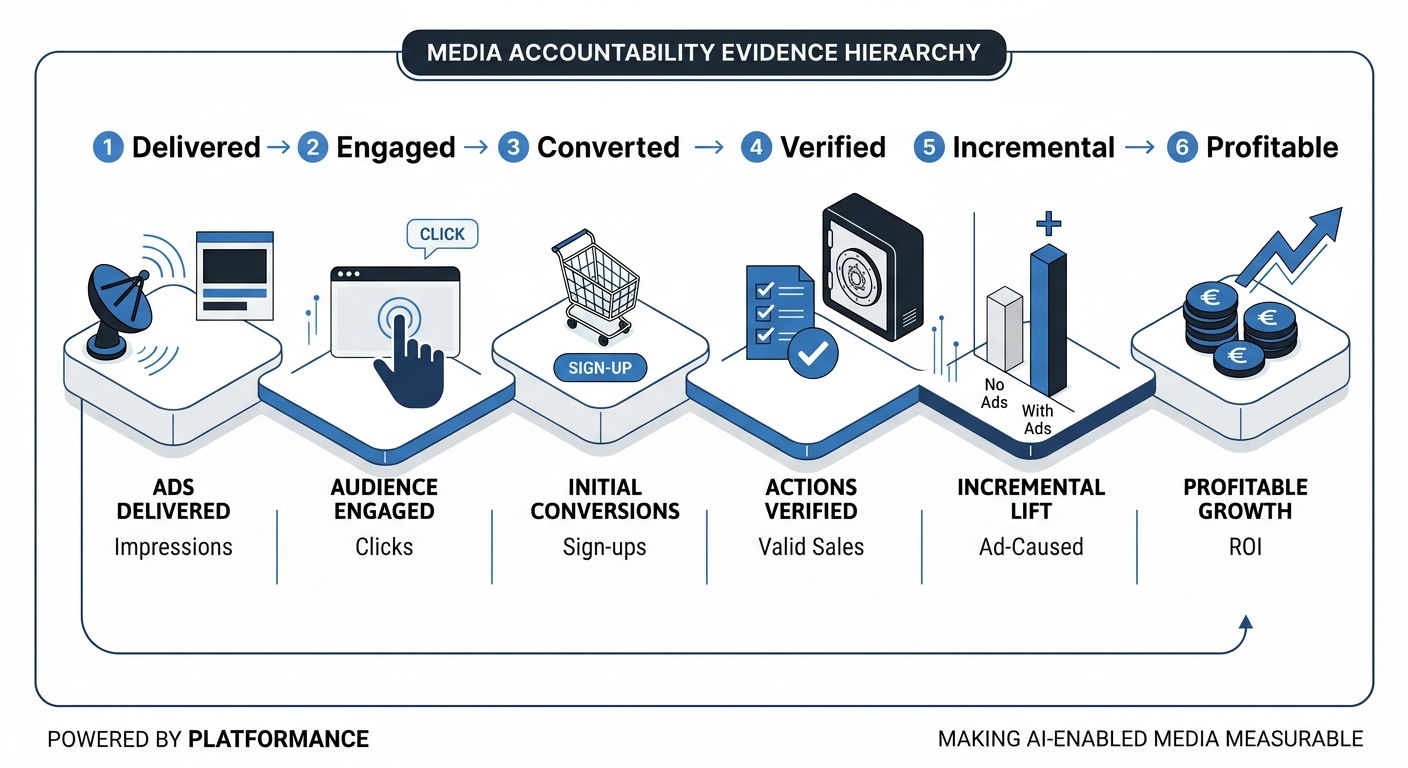
Each level answers a stronger business question.
Media accountability is achieved when campaign reporting can be connected with real business records, not merely when a platform dashboard shows improvement.
What Marketing Leaders Should Put in Place
An accountable media operating model requires:
A documented AI media policy
This should define approved applications, restricted use cases, permitted data, approval requirements, vendor standards and incident procedures.
Clear decision ownership
Every automated use case should have an identifiable business owner. Agencies and platforms may operate systems, but the advertiser should define the outcomes, acceptable limits and escalation rules.
Risk-based human oversight
Routine bid and pacing changes can be automated within agreed limits. Significant budget reallocations, regulated claims, new customer-data uses and measurement changes should receive greater human scrutiny.
NIST notes that human roles should be clearly defined and that the appropriate level of oversight depends on the system and its intended use. (NIST AI Resource Center)
Performance baselines and change logs
Advertisers should document what changed, when it changed and how performance compares with the previous process or a control group.
Without a baseline, an improvement may be incorrectly attributed to AI when it resulted from pricing, seasonality, product availability or another business change.
Ten Questions Every CMO Should Ask
- What business outcome is the system optimising?
- Which data sources influence its decisions?
- Who owns the campaign and customer data?
- Which results are observed and which are modelled?
- Can outcomes be reconciled with CRM or revenue records?
- How are attribution and incrementality distinguished?
- What can the system change without approval?
- Can the total media investment and associated fees be reconciled?
- How are fraud, bias, brand safety and unexpected behaviour monitored?
- Who is accountable when an automated decision fails?
AI Raises the Standard for Media Accountability
AI will become more deeply embedded in media planning, buying, creative production and measurement.
The competitive advantage will not come from automating the greatest number of decisions. It will come from automating decisions without losing control over outcomes, evidence and responsibility.
The strongest advertisers will move from campaign reporting to decision governance, from single-source attribution to evidence triangulation and from media efficiency to verified business performance.
AI should give marketing teams greater intelligence.
It should not require advertisers to surrender transparency or control.
Build a More Accountable Media Operating Model
Platformance helps brands connect AI-enabled media investment with verified business outcomes, transparent execution and stronger measurement.
Book a meeting with Platformance to review:
- Your current media accountability model
- AI-enabled planning and optimisation processes
- Attribution and outcome-verification gaps
- Media and fee transparency
- Human oversight and governance requirements
- Opportunities to align media investment with measurable business results
Book a meeting with Platformance
Frequently Asked Questions
What is media accountability?
Media accountability is the ability to verify where advertising investment went, what it delivered, how performance was measured and who is responsible for the decisions made.
How does AI affect media accountability?
AI can improve forecasting, optimisation and anomaly detection, but it can also reduce visibility into how audiences, budgets, creative and conversions are evaluated.
Can AI improve marketing attribution?
AI can analyse fragmented data and estimate missing signals. Modelled attribution should still be validated using first-party data, experiments, incrementality analysis and commercial evidence.
Who is responsible for an AI-driven media decision?
The advertiser and its appointed partners remain accountable. Responsibilities should be defined through governance policies, contracts, decision rights and approval thresholds.
Is platform-reported ROAS sufficient?
No. Platform ROAS is an operational metric. It should be reconciled with first-party sales, margin, retention, customer quality and incrementality evidence.
References
Interactive Advertising Bureau, State of Data 2025: The Next Evolution of AI for Media Campaigns
https://www.iab.com/insights/2025-state-of-data-report/
Interactive Advertising Bureau, IAB State of Data 2025: AI Is on the Brink of Transforming the Media Campaign Lifecycle
https://www.iab.com/news/iab-state-of-data-report-2025/
Association of National Advertisers, Q1 2026 Programmatic Transparency Benchmark
https://www.ana.net/content/show/id/pr-2026-05-programmatic
World Federation of Advertisers, Generative and Agentic AI Are Coming for Media
https://wfanet.org/knowledge/item/2025/09/02/ai-essentials-mit-reality-check-the-sustainability-paradox-us-deregulation-and-eu-code-of-practice
National Institute of Standards and Technology, AI Risk Management Framework Playbook
https://airc.nist.gov/airmf-resources/playbook/
National Institute of Standards and Technology, AI RMF: Govern
https://airc.nist.gov/airmf-resources/playbook/govern/
National Institute of Standards and Technology, AI RMF: Measure
https://airc.nist.gov/airmf-resources/playbook/measure/
National Institute of Standards and Technology, AI Risk Management and Human-AI Interaction
https://airc.nist.gov/airmf-resources/airmf/appendices/app-c-ai-risk-management-and-human-ai-interaction/
Why Platformance Is the Right Accountability Partner
Media accountability cannot be solved through technology alone. It requires alignment across media execution, commercial structures, first-party data, attribution, business outcomes and governance.
Platformance helps advertisers adopt AI-enabled media without losing control over investment, measurement or performance.
Our approach combines:
- Outcome design: Defining the business results, qualification criteria and success measures that media should deliver.
- Transparent media execution: Providing visibility into investment, channels, delivery and commercial structures.
- Measurement architecture: Connecting platform data with CRM, sales, revenue and first-party evidence.
- Outcome verification: Separating attributed activity from verified and incremental business results.
- AI decision governance: Establishing automation limits, human approval points and accountability owners.
- Continuous optimisation: Improving media performance while protecting data quality, brand standards and commercial value.
Platformance does not treat AI as a replacement for accountability. We use it as a capability within an accountable, outcome-led media model.
.jpg)